
God Does Play Dice: Einstein's Beautiful Mistake
In 1964 a physicist from Belfast turned a thirty-year argument into a single number you could measure. When the measurement finally came back, it broke something every physicist assumed was safe.


On Monday I left you in that room in Brussels with a promise and a small dishonesty.
The promise was that today I’d tell you what those twenty-nine people were actually arguing about. The dishonesty was that I made it sound like a fair fight. Two great men, two reasonable opinions, take your pick. It wasn’t like that. One of them was defending everything you already believe about how the world works. The other was defending something that sounds, the first time you hear it, completely unhinged.
Here’s the strange part. The one defending common sense was Einstein. And he was wrong.
I’m going to do this in a specific order. First I’ll walk you all the way over to Einstein’s side, until his position feels not just correct but obvious, the only sane thing a person could possibly think. Then I’ll show you the experiment that took that obvious, sane, common-sense picture of reality and quietly ended it.
What the fight was actually about
Strip away the equations and it comes down to two words. Locality and realism.
Realism is the belief that things have definite properties whether or not anyone is looking. The moon is a specific size and in a specific place right now, even though neither of us is checking. A coin in a closed box is already heads or already tails before you open it. Looking doesn’t create the answer. Looking just reveals an answer that was already sitting there.
Locality is the belief that nothing you do in one place can instantly change something in another place. Effects travel. They take time. Push something here and the push spreads outward, and the fastest that spreading can ever go is the speed of light. Nothing reaches across a gap and changes the far side of it in zero seconds.
Look at those two beliefs again and notice they don’t feel like physics. They feel like the definition of a sane person. Things are real when you’re not watching. You can’t touch something without reaching it. Einstein held both, completely, to the end of his life. So do you, whether or not you’ve ever put it into words.
Einstein’s actual weapon
In 1935, ten years before he died, Einstein wrote a paper with two younger colleagues, Podolsky and Rosen. It became the most cited thing he ever produced, which is remarkable for a man who also invented relativity. Everyone just calls it EPR now, after the three surnames.
The paper was not an attack on quantum mechanics’s math. The math worked, and Einstein knew it. It was an attack on the idea that the math was the whole story.
The move was this. Quantum mechanics allows two particles to be created together in a linked state, what we now call entangled. Send them flying apart, one to your left, one to your right, as far as you like. The theory says the two stay correlated: measure one, and you instantly know something about the other, no matter how much space is between them.
Einstein looked at that and saw a trap with only two ways out.
Either measuring the particle on the left physically reached across all that empty space and set the property of the particle on the right, faster than light, instantly, which violates locality and which Einstein considered frankly absurd. He had a name for it. Spooky action at a distance.
Or the far particle already had that property the whole time, sitting there fully formed since the moment the two were born, and quantum mechanics simply doesn’t include it in the description. Which would mean the theory isn’t wrong, just incomplete. There’s more underneath. Hidden machinery the equations don’t mention.
Einstein took the second door without blinking. Of course the properties are already there. Of course there’s hidden machinery. The alternative is spooky nonsense. The dice only look random because we haven’t yet found the thing that loads them.
And sit with that for a second, because he’s clearly right. Isn’t he? The idea that a particle has no real location, no definite properties, nothing settled about it at all until someone measures it, and that measuring it here instantly yanks its partner into agreement across a light-year of empty space, that isn’t science. That’s a magic trick. Einstein is just refusing to be fooled by one. The properties are real. The world is local. We’re missing a piece, and one day someone will find it.
For thirty years, almost everyone who thought about it seriously agreed there was no way to know. It sounded like philosophy. You cannot put “is the coin heads before you open the box” on a lab bench. The whole disagreement looked permanently stuck: two brilliant men, two tastes, and no experiment in the universe that could tell them apart.
The man from Belfast
Then a physicist named John Stewart Bell, born in Belfast, working at CERN, did something nobody had managed in three decades.
Bell’s day job was ordinary particle physics. The EPR question was a thing he worried at in the margins, almost a hobby, the way other people do crosswords. And in 1964 he stopped asking which picture of reality was prettier, Einstein’s or Bohr’s, and asked a completely different question. A measurable one.
If Einstein is right, he said, if every particle really does carry its properties with it from birth, then what would we actually see in the lab? Not in principle. In numbers. On a readout.
When he worked it out, Einstein’s picture and quantum mechanics’s picture did not predict the same numbers. They came apart. Which meant the thirty-year standoff was never really about taste at all. It had a fact underneath it the entire time, and the fact could be measured. You just had to know what to count.
The two machines
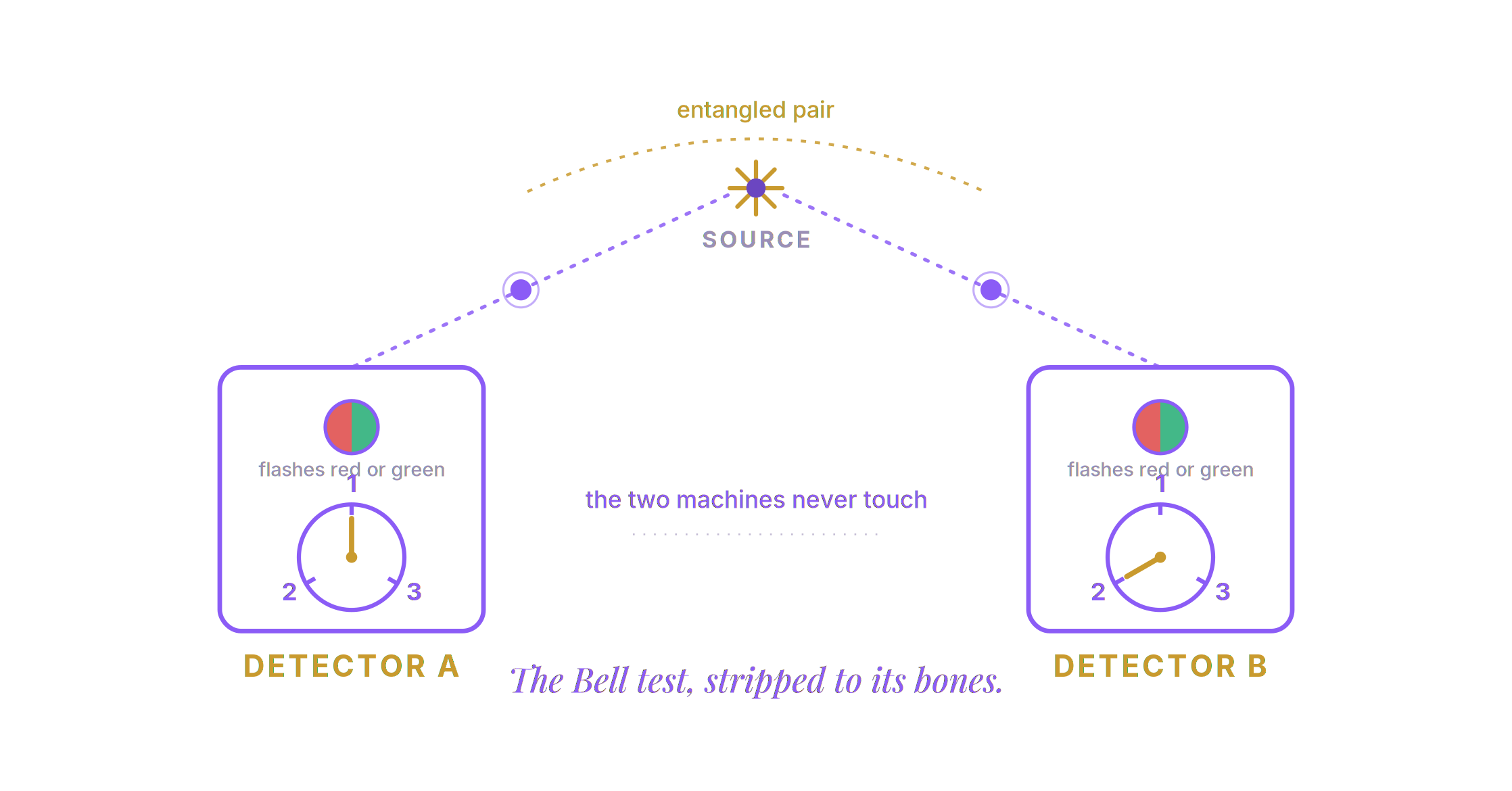
Here’s the setup, as clean as I can make it. Forget particles for a moment and picture two machines.
Each machine has a dial with three settings, marked one, two, three, and a single lamp on the front that flashes either red or green when a particle arrives from a source in the middle. That’s it. A dial and a lamp. You set the dial, a particle comes in, the lamp flashes a colour. The two machines can be across the room from each other, or across a country. There’s no wire between them and no way for one to signal the other.
Now run the thing thousands of times. Each run, both dials are set at random, independently, and both lamps flash.
Two facts come out of the data. Both are measured. Both are real. Everything hangs on these two, so hold onto them.
Fact one. Whenever the two dials happen to land on the same setting, the two lamps always flash the same colour. Both on setting one? Both red, or both green, every single time. Both on three? Same colour, always. Never once a mismatch when the settings match. Perfect agreement.
Fact two. Across all the runs, mixing every combination of settings together, the two lamps flash the same colour half the time. Fifty percent.
Look hard at fact one, because fact one is Einstein’s entire case handed to you on a plate. Two machines, no connection, sometimes far enough apart that not even light could carry a message between them in time, and yet when you set them the same they agree without fail, run after run after run. How? There is exactly one sane explanation, and it’s his. Each particle must leave the source already carrying its answers. A little sealed slip of paper: setting one, red. Setting two, green. Setting three, red. The two particles are twins carrying identical slips. That’s the only way they could possibly agree every single time without communicating. The colours were decided at the source, in advance, and carried out to the machines. The answer was there all along.
That is not a loose analogy. That is the whole of Einstein’s position, made physical. The properties are real before measurement. The world is local. The slip exists.
So Bell asked the one question left. Fine: if every particle carries a slip, then fact two is not free to be anything it likes. The slips constrain it. There’s a limit to how those numbers can come out, once you accept the slips are real. Bell sat down and calculated exactly what that limit is. A hard floor. A number that fact two is simply not allowed to fall below, if Einstein is right and the slips exist.
Then people built the machines and measured it.
Not once. Dozens of times, across fifty years, sealing off every possible way the universe might be cheating, one loophole at a time, all the way to a Nobel Prize in 2022.
Reality came back on the wrong side of Bell’s floor.
Keep reading with a 7-day free trial
Subscribe to Physics Gene to keep reading this post and get 7 days of free access to the full post archives.