
Nature Hates Infinity
Every time the equations cough up infinity, something has just broken. Except, maybe, in the one place we can never go to check

Monday I left you somewhere uncomfortable. Two sizes of infinity. One bigger than the other, both of them endless, proved by a man with nothing but a list and a diagonal line drawn through it. By the only definition of “same size” that survives contact with infinity, there are more real numbers than counting numbers, and there is nothing you or I can do to fix that.
But notice where I went quiet at the end. Cantor did all of that inside mathematics. Inside our heads. A cathedral built out of pure logic, beautiful and airtight, and not one stone of it has to touch the actual universe. The one made of atoms and starlight and the cup cooling in your hand.
So here is the question to make things interesting. Is any of that infinity real? Is there anything out there, in the physical world, that truly never ends?
Math and physics do not agree always.
Let’s start where everyone starts. The obvious one.
Is the universe infinite?
The most obvious place to look
Your gut again already has an answer, and it’s the same gut feeling from Monday. Whatever number I give you, you add one. Whatever edge I draw on the universe, you ask what’s on the other side of it. Space can’t just stop. There can’t be a brick wall at the end with nothing behind it. So it must go on forever.
It’s a good instinct. It’s also not quite an argument.
Because “no edge” and “infinite” are not the same thing. Walk in a straight line on the surface of the Earth and you never hit an edge, never fall off, never find a wall. You come back to where you started. The surface is finite and has no boundary at the same time. So the universe has two ways to have no edge. It can go on forever, truly infinite. Or it can be finite and quietly curve back on itself, and you would never feel the seam.
Which one is it? That turns out to be a question you can measure. The trick is geometry. Draw a big enough triangle across the sky and add up its angles. In a curved, closed universe they come out to more than 180 degrees. In an open one, less. In a flat one, exactly 180. So we built the biggest triangles we could, using the oldest light in existence, the faint afterglow left over from the early universe, and we measured the angles.
The answer came back flat. As flat as we can measure, with any leftover curvature pinned down to within a fraction of a percent.
Flat is the geometry of something infinite. It whispers forever. And for a second that feels like the answer.
Then the catch arrives, and it’s the same wall I wrote about back in the spring. We can only ever see a finite piece of it. Light has had a little under fourteen billion years to travel, so we sit at the center of a bubble of everything light has had time to reach, and that bubble is roughly ninety-three billion light years across.
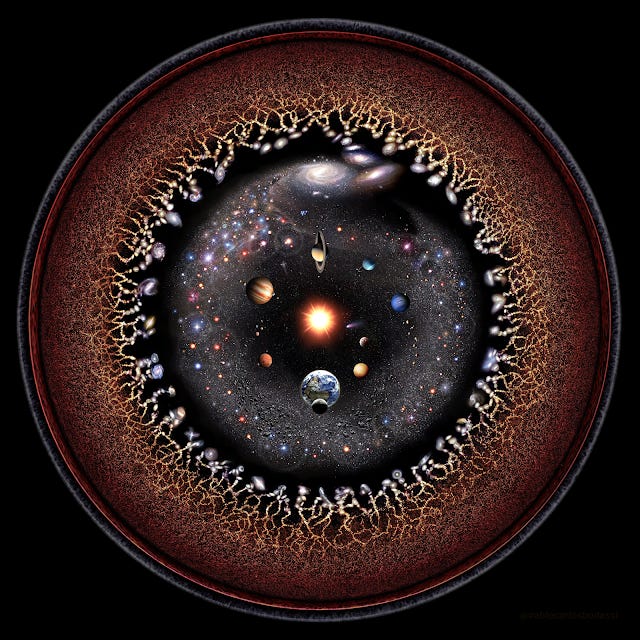
Beyond its edge, light simply hasn’t gotten here yet. Worse, the universe is expanding, the far parts racing away faster than their light can close the gap, so most of what is out there will never reach us. Not ever.
So even if space goes on forever, we are sealed inside a finite room with no door, measuring the walls and trying to guess the size of a house we can never walk through. And flat space has one last trick in it. It could still be closed, wrapped around on itself like the screen in an old arcade game where flying off the right edge brings you back on the left. From the inside, it would look exactly as flat and endless as the real thing.
So. Is the universe infinite? The honest answer is that we don’t know, the measurement leans toward yes, and we may have been born into a universe built specifically so that we can never find out.
I could leave it there. Plenty of people do. But the size of the universe turns out to be the least interesting place infinity shows up in physics, and by a wide margin the hardest to settle.
Because the truly strange infinities aren’t waiting out at the edge of space. They’re sitting in the middle of our most precise, most trusted equations. And when infinity shows up there, it almost never means “this goes on forever.” It means something just broke. Every time physics writes down an infinity, nature is handing us a note. And the note nearly always says the same thing.
Monday I showed you infinity the way a mathematician meets it. A place you can walk toward, measure, and compare. Today I want to show you infinity the way a physicist actually meets it. Which is as an alarm going off in the dark.
Keep reading with a 7-day free trial
Subscribe to Physics Gene to keep reading this post and get 7 days of free access to the full post archives.