
Something Is Outrunning Light
It happens millions of times a second inside nuclear reactor pools. The blue glow is what losing the race looks like.

There is a room in every nuclear power plant that visitors never forget.
You stand on a metal walkway above a pool of water so clear it barely seems to exist. Twelve meters down, spent fuel rods sit in steel racks, quietly radioactive, hotter than anything you will ever be near. And around them, the water glows. Not a reflection, not a trick of the lighting. The water itself shines with a deep electric blue, as if someone drowned a piece of the sky.
Engineers walk past it every day. Ask them, and most will admit it is the most beautiful thing they have ever seen at work. Very few can tell you what it actually is.
Here is what it is: a shock wave made of light.
Which is a problem, because on Monday we agreed that such a thing should be impossible. Let me remind you why.
A jet flying slower than sound stays comfortably behind the waves it emits. They ripple out ahead of it and warn you it is coming. But push the jet past the speed of sound and the situation breaks. Every new wavefront is now born ahead of where the previous one started, and none of them can escape forward anymore. They stack, one on top of another, into a single wall of compressed air trailing off the jet in a cone. When that wall sweeps over you, you hear the crack of a sonic boom.
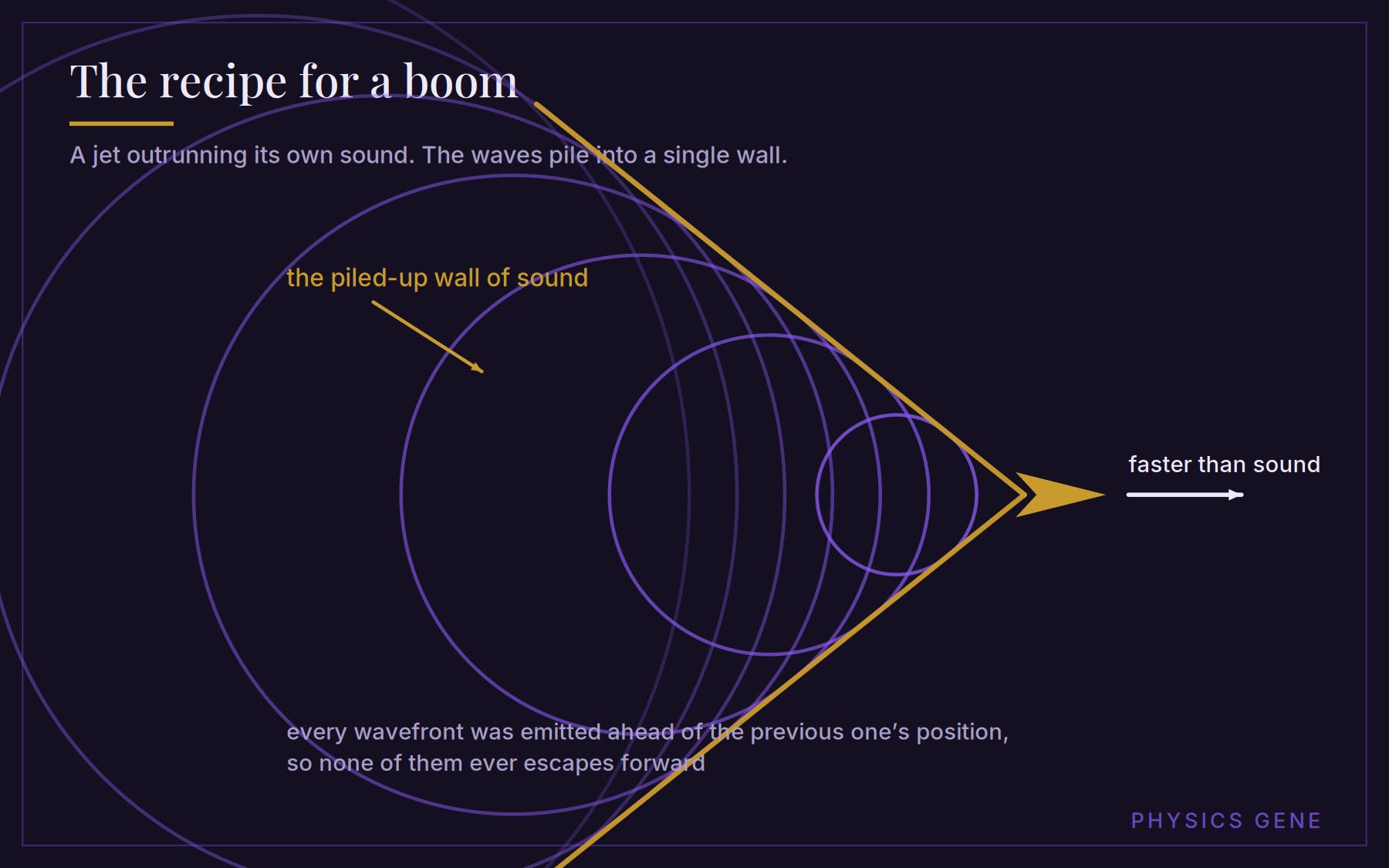
So the recipe for a boom is short: the source has to outrun its own waves.
And that is exactly why a boom made of light should not exist. Light in empty space moves at 299,792 kilometers per second, and relativity is brutal about that number. You can accelerate an electron for a billion years and it will creep closer and closer to that speed without ever touching it. Nothing carrying matter, energy, or information gets there. There is no outrunning light, so there should be no boom.
Now come with me to Leningrad, in the early 1930s, into a basement laboratory.
A doctoral student named Pavel Cherenkov had been handed one of the least glamorous projects in physics: expose various liquids to radiation from radium, and carefully measure the faint fluorescent light the liquids give off. Routine work. The kind of thesis that fills a drawer and is never opened again.
The measurements were miserable to perform. The electronic light detectors that fill modern labs did not exist yet, so Cherenkov’s detector was his own eye. Before every session he sat in absolute darkness, often for an hour or more, until his vision grew sensitive enough to register the faintest traces of light. Then, half blind in the dark, he would peer at his samples and judge their brightness by eye. He did this for years.
And week after week, one detail refused to make sense.
There was always a faint blue glow, even when nothing in the liquid should have been able to fluoresce. Pure water glowed. Distilled solvents glowed. He purified his liquids again and again to strip out any contaminant, and the blue light stayed, always the same, no matter what the liquid was.
Fluorescence does not behave that way. Fluorescence depends on the specific molecules doing the glowing, changes from substance to substance, and can be poisoned by chemicals that absorb the energy first. Cherenkov added those chemicals. The blue light ignored them completely.
Then he found something stranger. Fluorescence glows outward in every direction, like a lamp. This light did not. It was directional. It swept forward along the path of the radiation, the way a wake trails a speedboat.
A lamp shines. A wake follows. And a wake is what shock waves look like.
Cherenkov published his measurements, and much of the physics world shrugged. A glow with no substance responsible for it sounded like sloppy experimental work, and by some accounts one prominent Western journal turned his paper away. He went back into the dark room and kept measuring anyway, with nothing but his eyes.
He could not have fully known it yet, but he was staring at the impossible thing: light behaving exactly like a sonic boom. Something in that water was outrunning light.
But nothing outruns light. That is the one law physics never bends.
Unless you go back and read the law again, slowly, and notice the fine print.
Keep reading with a 7-day free trial
Subscribe to Physics Gene to keep reading this post and get 7 days of free access to the full post archives.