

A lithium level came back at 1.4 in my psychiatry rotation, and I thought about it way to much at that time.
Not because 1.4 is a catastrophe. It isn’t. We aim for somewhere between 0.6 and 1.2, and 1.4 means you call the patient, ask about the vomiting bug they had over the weekend, ask whether anyone started them on an anti-inflammatory, hold a dose, recheck. Ordinary work.
What stopped me was smaller than that. Lithium is the oldest drug in psychiatry. John Cade published the result in 1949, before the structure of DNA, before anyone had a coherent theory of how a neuron signals. Seventy-seven years later we still prescribe it, we still monitor it every three months, and we still cannot say with confidence what it actually does in there. There are theories. Inositol depletion. Enzyme inhibition. Good theories, argued over for decades, none of them closed.
So the drug is an atom. Three protons, three or four neutrons, an electron shell. Nothing else. And it is the most reliable mood stabiliser we have, and we don’t know why. Trust me, you know many people who are taking lithium, it’s very common.
That gap is where today’s story starts.
Monday I left you holding ten million volts per meter across every membrane in your body, and promised we’d find out whether anything in that dark is computing. Here is the case, both sides of it, as honestly as I can lay it out.
The physicist who got sick
Matthew Fisher is not a fringe figure. He works on quantum phase transitions at UC Santa Barbara, he shared the Oliver E. Buckley Prize in 2015, his father is a well known statistical physicist at Maryland and his brother is at Stanford. This is a physics family, and he is a serious member of it.
In February 1986 he woke up feeling as though he had been drugged. Extra sleep didn’t touch it. Diet, exercise, bloodwork, all normal, all useless. He has described it as a migraine spread over his entire body, every waking minute, and it lasted two full years. It got dark enough that he thought about ending it, and by his own account what kept him going was the birth of his first daughter.
Eventually a psychiatrist put him on a tricyclic. Within three weeks the fog thinned. Within nine months he felt like a different person. He later moved to Prozac and has been adjusting the regimen ever since.
Then he did the thing that makes him a physicist rather than a patient. He went looking for the mechanism, expecting to find one, and discovered that nobody had it. The drugs worked. The explanation was a shrug.
He spent the next five years teaching himself neuroscience and biochemistry, and he started where I started, with lithium, for exactly the reason I gave you above. Every other psychiatric drug is a complicated molecule with a dozen places to hide. Lithium is one atom. If something strange is happening, an atom is the cleanest place to catch it.
Or is it…
The loophole
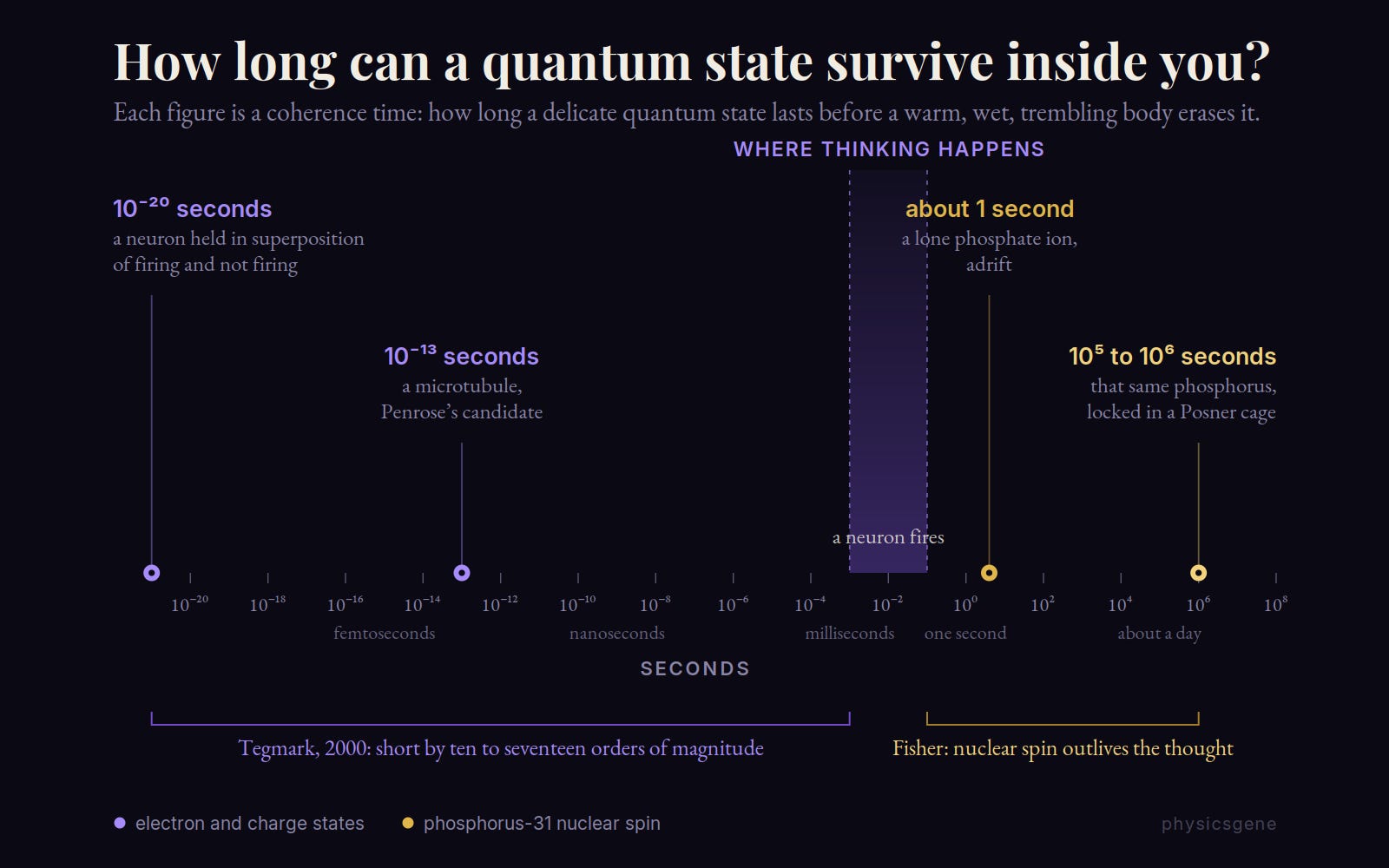
You already know the objection, because I gave it to you on Monday. In 2000 Max Tegmark calculated how long a quantum state could survive inside a working brain and got somewhere between 10⁻¹³ and 10⁻²⁰ seconds. Thinking happens on the scale of milliseconds. The mismatch runs to ten orders of magnitude and beyond, and for most physicists that closed the file.
Read Tegmark’s paper carefully, though, and you notice what he actually calculated. He looked at a neuron in superposition of firing and not firing. He looked at Penrose’s microtubules. Both of those are stories about electrons and moving charge, and moving charge is loud. It shoves the surrounding water around, and the water shoves back, and the state is gone.
An atomic nucleus is a different object. Tuck a nucleus inside its own electron cloud and it barely converses with the outside world at all. This is not exotic physics. It is the entire reason MRI works: we can address nuclear spins in a living human body and they hold their orientation long enough to be useful.
So Fisher asked a narrower question than anyone had been asking. Not whether the brain is a quantum computer. Whether there is any degree of freedom in the brain that Tegmark’s arithmetic does not reach.
He found one candidate, and only one.
Why it has to be phosphorus
For a nucleus to work as a qubit you want spin one half. Higher spins carry an electric quadrupole moment, which is a handle the environment can grab, and they decohere faster.
Go through the elements your body is actually built from and the list collapses almost immediately. Oxygen-16, spin zero, useless as a qubit. Calcium-40, spin zero. Nitrogen-14, spin one. Carbon-13 is spin one half but only about one carbon atom in ninety is carbon-13. That leaves hydrogen, which is spin one half and is also absolutely everywhere, which makes it noise rather than signal.
And it leaves phosphorus-31. Spin one half. The only stable isotope phosphorus has, so every phosphorus atom in you is one. And phosphorus is not some trace element: it is the backbone of your DNA, the P in ATP, half the surface of every cell membrane you own.
There is a catch, and Fisher is upfront about it. A phosphate ion floating loose in body fluid holds a quantum state for roughly a second before a proton binds to it and wrecks everything. A second is not nothing. It is also not a memory.
Unless you could keep the protons off it.
The cage
Calcium can outcompete a proton for a phosphate. We have known this for a long time, in the most literal way possible, because it is what bone is.
In 1975 a Cornell scientist named Aaron Posner was looking at X-rays of bone mineral and noticed a recurring cluster: nine calcium atoms and six phosphates, packed into a small, almost cubic knot. The structure was named after him. Decades later, when researchers simulated bone growth in artificial body fluid, the same clusters turned up floating free in the liquid.
Look at what that cluster is made of. Calcium, nuclear spin zero. Oxygen, nuclear spin zero. Six phosphorus nuclei sitting on the faces of a cage built entirely out of silence.
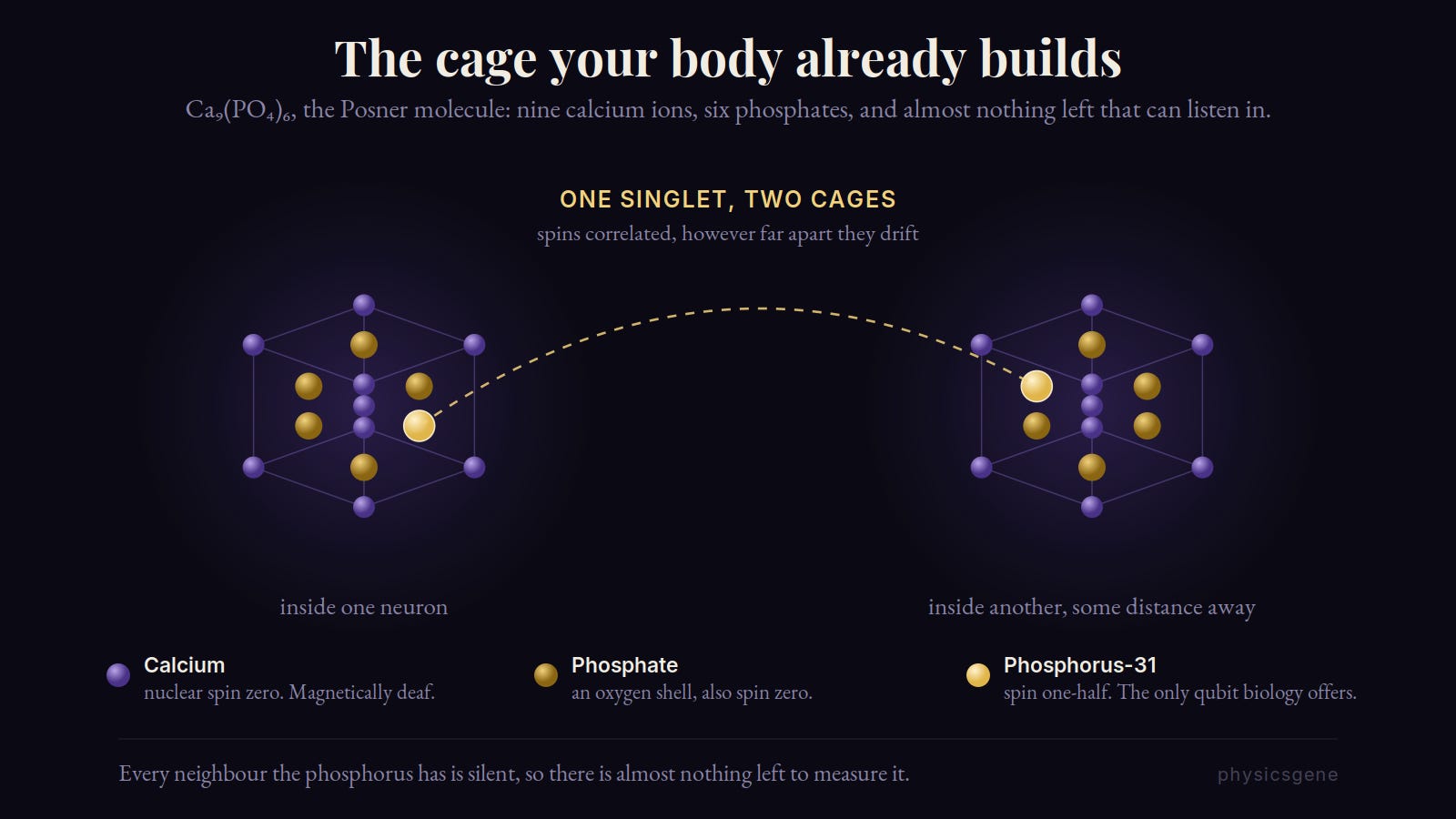
Fisher’s estimate for how long a phosphorus spin survives in there is not a second. It is 10⁵ to 10⁶ seconds. A day at the low end. Longer at the high end, and in a later paper he pushed it to three weeks.
The full proposal has more moving parts than I can fit here, but the spine of it runs like this. Your cells constantly split pyrophosphate into two phosphate ions using an enzyme, and Fisher argues the geometry of that reaction leaves the two phosphorus nuclei entangled as they separate. Each one gets absorbed into a Posner cluster, which protects it. The clusters drift, get taken into different neurons, and when two of them bind and break apart they release a burst of calcium. Calcium is the trigger for neurotransmitter release. So if two entangled clusters melt in two distant neurons, those neurons fire in a correlated way that no classical account would predict.
That is a real mechanism. It names molecules, reactions, and an output you could in principle go and measure. Whatever else you think of it, it is not hand-waving.
The experiment that shouldn’t have mattered
A beautiful mechanism is not evidence, and Fisher knew it. So he went looking for something already sitting in the literature that his idea could explain and ordinary chemistry could not.
He found it in 1986, the same year he got sick.
At Cornell, a group led by Jeri Sechzer had given lithium to female rats before and during pregnancy. Not lithium in general. Lithium separated into its two stable isotopes. Lithium-7, which is ninety-two and a half percent of the lithium in the bottle at your pharmacy, and lithium-6, which is the rest.
Chemically these are the same element. Same three protons, same electron shell, same reactions in every way a chemist normally cares about.
Then the pups were born, and the mothers behaved differently depending on which isotope they had been given. The lithium-7 mothers largely ignored their pups and nursed them rarely. The lithium-6 mothers groomed and nursed more than untreated mothers did.
Opposite directions. From one neutron.
For Fisher this was the loose thread. Lithium-6 and lithium-7 have different nuclear spins. If nuclear spin is doing real work inside a mammal, this is what it would look like from the outside.
That is the case for the defence, and I have given it to you at full strength, because what comes next is not kind to it.
Since 2018 four separate groups have stopped arguing about Fisher’s molecule and started measuring it. Not modelling it. Measuring it. Real phosphorus, real magnets, the exact entangled state his proposal requires, and a clock.
Their numbers are below.
So is what happened when Fisher flew to Stanford to run the rat experiment again himself, which is the part I find hardest to write about, because he is the last person on earth who wanted it to come out the way it did.