
The Universe Should Be Empty
In the spring of 1964, on opposite sides of New York City, two teams of physicists were being annoyed by their equipment.

In Holmdel, New Jersey, two radio astronomers named Arno Penzias and Robert Wilson had a horn-shaped antenna the size of a bus and a problem they could not get rid of: a faint, steady microwave hiss, the same in every direction, day and night, summer and winter. They checked the wiring. They pointed the horn away from the city. They evicted a pair of pigeons nesting inside it and scrubbed out what Penzias politely recorded as white dielectric material. The hiss stayed.
A couple of hours’ drive east, at Brookhaven on Long Island, a team led by James Cronin and Val Fitch was watching a subatomic particle do something it was strictly forbidden to do, and rechecking their machine for the fault that had to explain it, because the alternative was unthinkable.
Neither team knew it, but they were holding the two halves of the same story. It is the story of the greatest disaster that ever happened, and of the accounting error that saved you from it. On Monday I showed you the mirror: every particle of matter has an antimatter twin, identical in mass, opposite in charge, and when twin meets twin, both vanish into light. Today I have to show you what that mirror almost did.
The factory only makes pairs
Start with the one thing every experiment on Earth agrees about. Energy can become matter. That is E = mc² read from right to left, and we do it daily in colliders: pour enough energy into a point and particles condense out of it like dew. But they never condense alone. Creation is symmetric. Make an electron and a positron appears with it. Make a proton, and an antiproton is born in the same instant. Across a century of particle physics and trillions upon trillions of collisions, nobody has ever created a piece of matter without its mirror twin. The books always balance.
Now run the Big Bang under that rule.
The early universe was pure energy at temperatures with no name, condensing into particles everywhere at once. Symmetric creation on the grandest scale there will ever be: for every particle of matter, a twin. Then the universe expanded and cooled, creation slowed, and the meetings began. Twin found twin. Annihilation everywhere, an entire cosmos un-happening, matter and antimatter erasing each other back into light within the universe’s first fraction of a second.
Follow the rule to the end and the prediction is clean. Everything meets its twin. Everything cancels. What remains is a universe of light, expanding and cooling forever, perfectly empty of matter. No atoms ever form, no stars ignite, and no one is ever there to notice.
That empty universe is the one our laws predict. It is, by every account we know how to write down, the correct outcome.
It is also, you may have noticed, not what happened.
The audit
So count what actually exists. Count the matter: every galaxy, every star, every atom of you. Then count the light: the sea of ancient photons left over from the early universe. The ratio comes out to more than a billion photons for every single surviving particle of matter.
Read as a receipt, that number tells a precise story. For every billion pairs of twins that met and annihilated, turning themselves into that light, one particle of matter stood alone with no twin to meet. A billion and one against a billion. The billion pairs became an ocean of photons. The one became everything else.
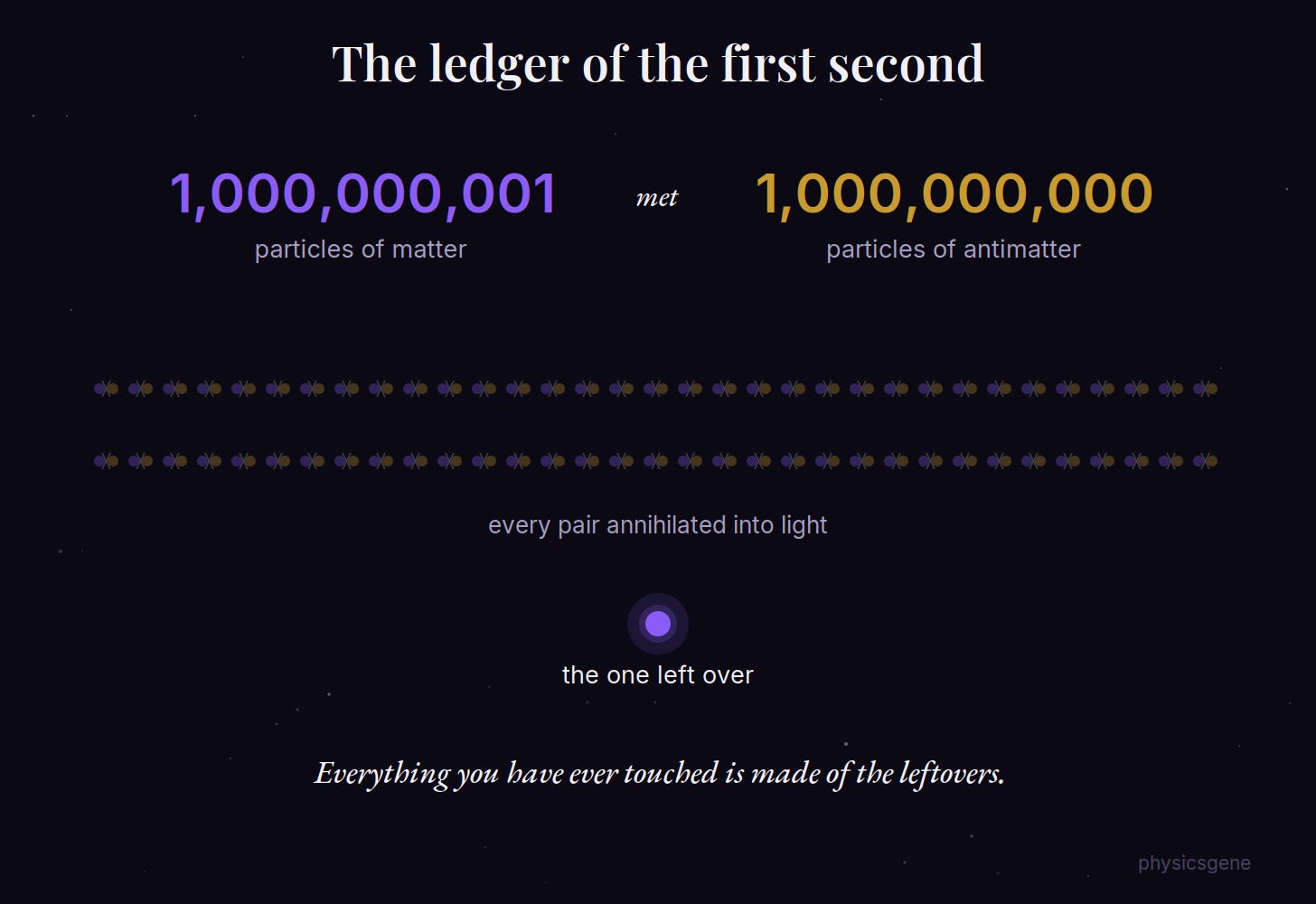
Caption: A billion and one against a billion. The pairs became light. The ones became you. Alt text: Two large numbers, 1,000,000,001 particles of matter in purple against 1,000,000,000 particles of antimatter in gold, above rows of faded annihilating pairs and one bright surviving purple particle labeled the one left over.
You are not made of the universe’s main event. The main event was the annihilation, and the light it produced outnumbers you a billion to one. You are made of the rounding error. Every mountain, every ocean, every person you have ever loved is built from the one-in-a-billion survivors that, for some reason nobody can name, had no partner waiting.
Which brings us back to the hiss in New Jersey.
That ocean of light never went anywhere. It has been traveling for 13.8 billion years while space expanded beneath it, its waves stretched from blinding glare down to faint microwaves, and it arrives today from every direction at once: about 400 ancient photons in every cubic centimeter of space, including the cubic centimeter in front of your eyes right now. That is what the horn in Holmdel was hearing. The hiss Penzias and Wilson could not remove was the oldest light in existence, the surviving glow of the fireball the great annihilation poured its energy into, the very light against which we count the missing antimatter. They had tuned into the receipt. It earned them the Nobel Prize, and it is still falling on your roof tonight.
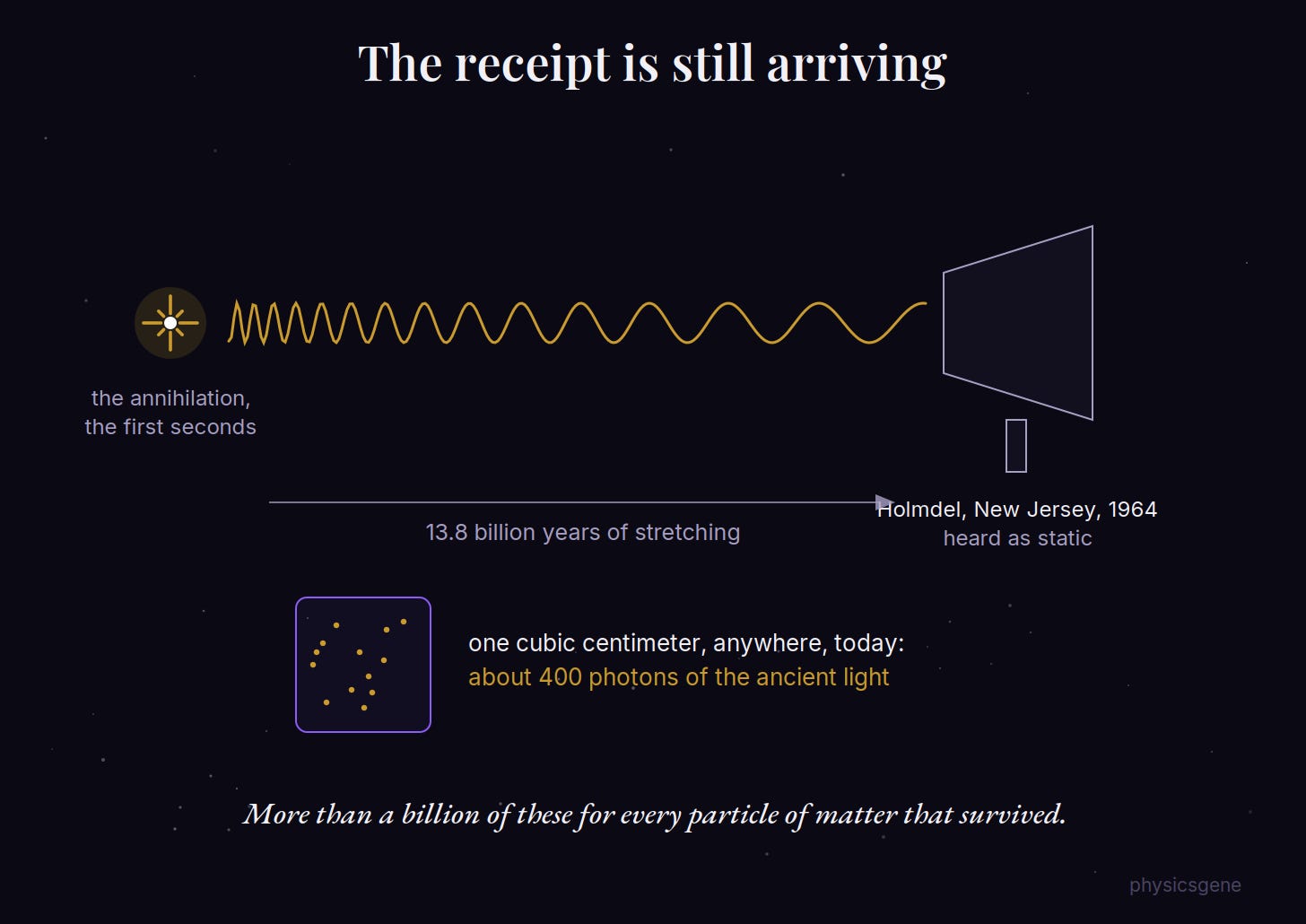
Caption: The flash never faded. It stretched. Alt text: An annihilation starburst on the left sends a wave whose wavelength visibly stretches as it travels toward a horn antenna labeled Holmdel, New Jersey, 1964, heard as static. Below, a small cube represents one cubic centimeter of space today, containing about 400 photons of the ancient light.
The escape hatch
Now, there is an obvious way out of this whole problem, and I want to close it properly, because it is the first thing everyone thinks of. Maybe nothing went missing. Maybe the antimatter is simply somewhere else. Half the universe minted in matter, half in antimatter, separated early, and somewhere out there are antimatter galaxies with antimatter stars warming antimatter worlds, whose astronomers count their leftover photons and wonder where all the matter went.
It is a lovely idea, and the sky says no. Space is not empty enough to keep the halves apart. Galaxies collide, gas drifts between them, cosmic rays cross the whole galaxy and land in our detectors. Wherever a matter region touched an antimatter region, the border would burn, a permanent front of annihilation blazing in gamma rays. We have mapped the sky in gamma rays for decades, and there are no burning seams. The cosmic rays raining onto Earth from across the galaxy are matter, essentially without exception, and a detector bolted to the International Space Station has spent more than a decade sifting them for a single confirmed nucleus of primordial antimatter. Nothing confirmed yet.
The antimatter is not hiding. It is gone, annihilated down to the last speck. And that leaves exactly one way out, and it is the scandalous one.
If creation is perfectly symmetric, we do not exist. We exist. Therefore, somewhere in the deep laws, the symmetry must fail. The mirror I showed you on Monday, the one physics spent three decades polishing, must have a flaw: some process in nature must treat matter and antimatter differently, must tilt, however slightly, toward us.
For years that idea sat close to heresy, because the mirror had passed every test. Physicists had already caught nature cheating one reflection: in 1957, an experiment led by Chien-Shiung Wu showed the weak force can tell left from right, which was shocking enough. But the repaired, combined mirror, swap every particle for its twin and flip space like a glove, was declared truly fundamental after that. Sacred, even. It had to be.
Which returns us, at last, to Long Island, spring of 1964, and to the particle in Cronin and Fitch’s detector that was doing the forbidden thing. They spent months hunting for the flaw in their own machine, because the only other option was a flaw in the universe.
They published. The flaw was in the universe.
Keep reading with a 7-day free trial
Subscribe to Physics Gene to keep reading this post and get 7 days of free access to the full post archives.