
What You’re Actually Looking At
The reddish star at Orion's shoulder is 550 years old, possibly already dead, and not where you think it is. Tonight, look up.

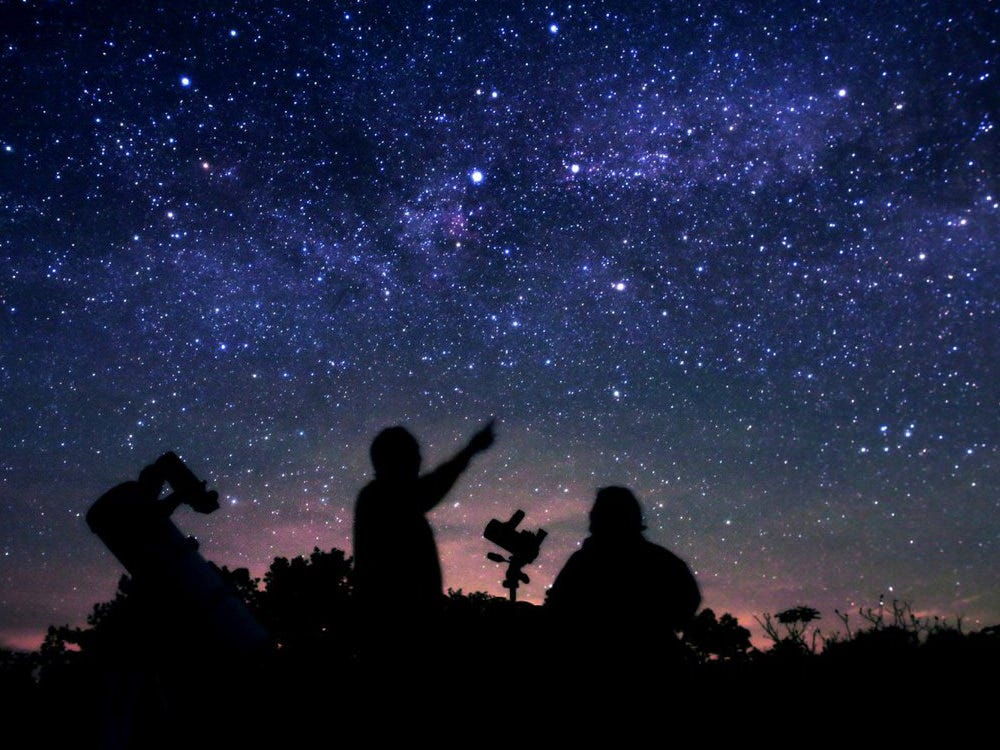
I’ll be honest: I didn’t even like astronomy at first.
I loved physics. I always loved physics. But astronomy felt like the soft cousin, the subject sophomores got excited about because it sounded cool, even though we never really learned anything about it. I remember being mildly dismissive of the whole thing. Even when the first image of a black hole came out, the M87 photograph everyone lost their minds over, I looked at it and felt mostly nothing…
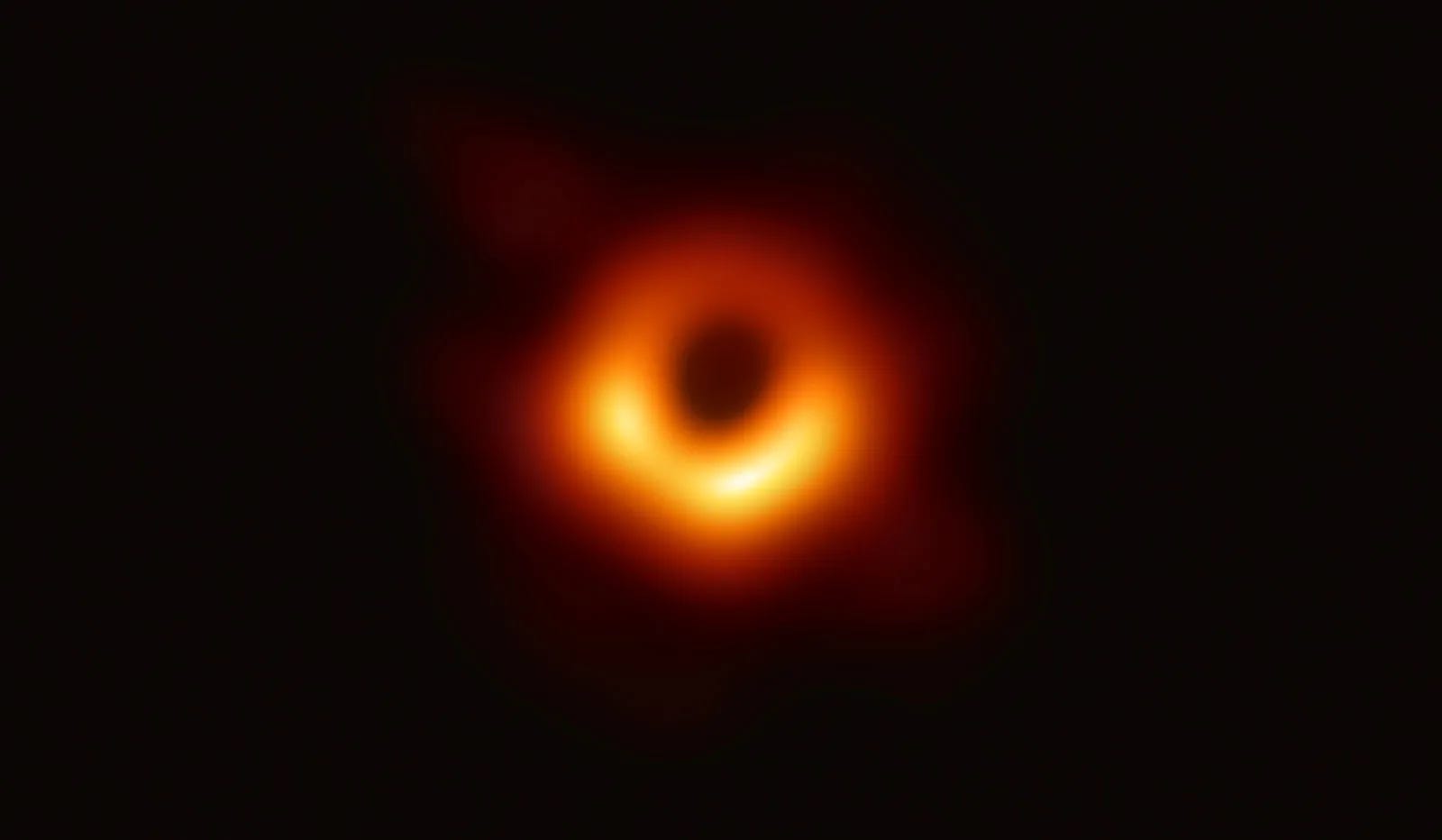
Then, slowly, something shifted. I started reading. I got pulled in. And the same image of this black hole that had left me cold a few months earlier, like everything in the universe, sucked me in.
That’s when I figured it out. Astronomy to my soul is what physics is to my mind. Physics amazes my brain with new rules and ways to describe what I think I know. Astronomy does something else entirely. It makes me feel small, and somehow alive at the same time. I’m not really a spiritual person. But I don’t have another word for what looking up does to me.
I won’t pretend I can describe it.
I’ve tried. I usually fail. There’s something about standing in the dark, head tilted up, that I don’t have language for, and I’ve made my peace with the fact that I probably never will. But I can tell you what’s actually happening when you look up. And I think that does some of the work for me.
So: tonight, find Orion.
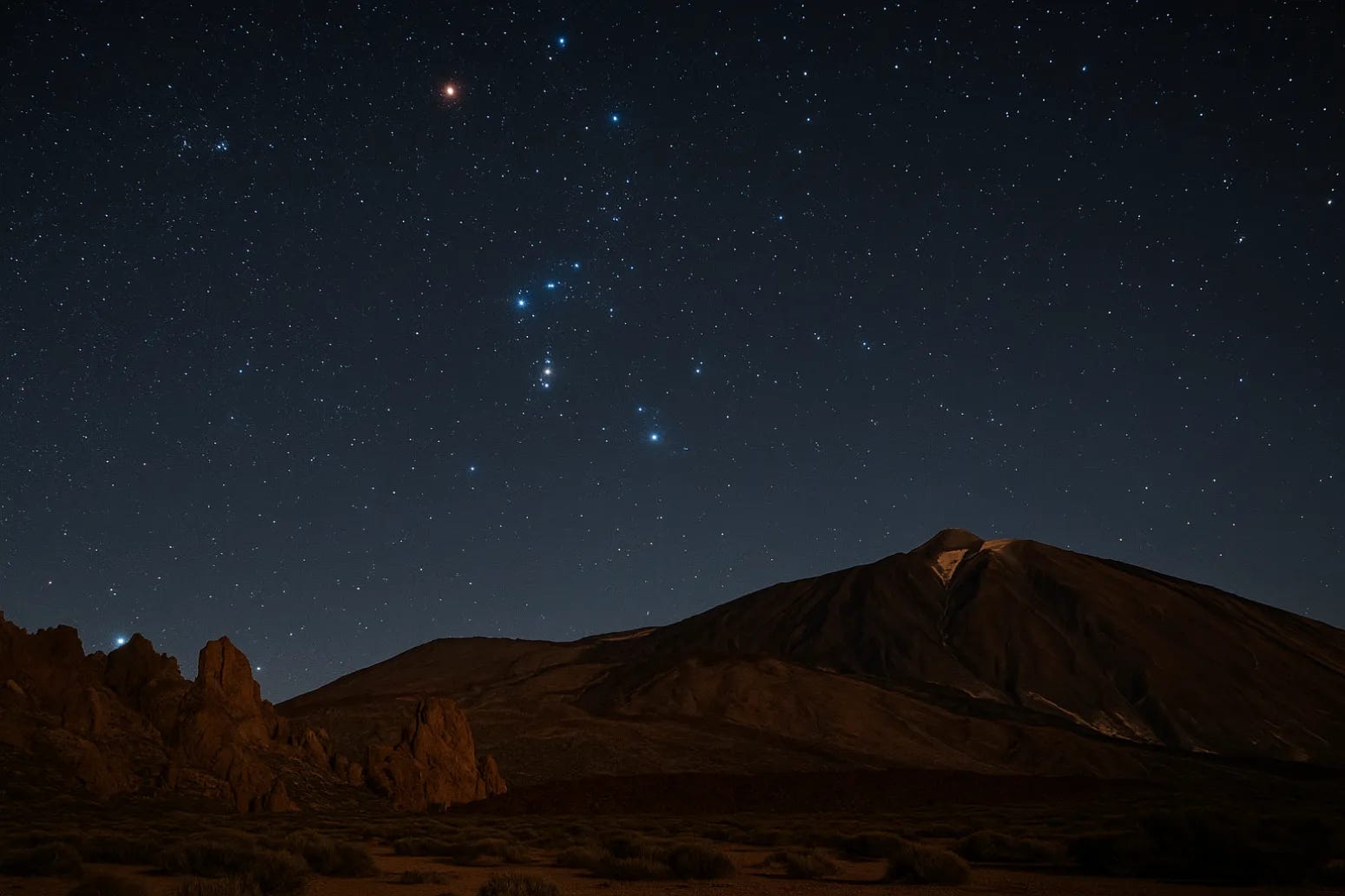
You know the one. Three stars in a row for the belt, four corners around it. Almost everyone can find Orion (when the sky is clear), even people who’ve never tried. Now look at the top-left corner, the bright reddish star at the hunter’s shoulder. That’s Betelgeuse.
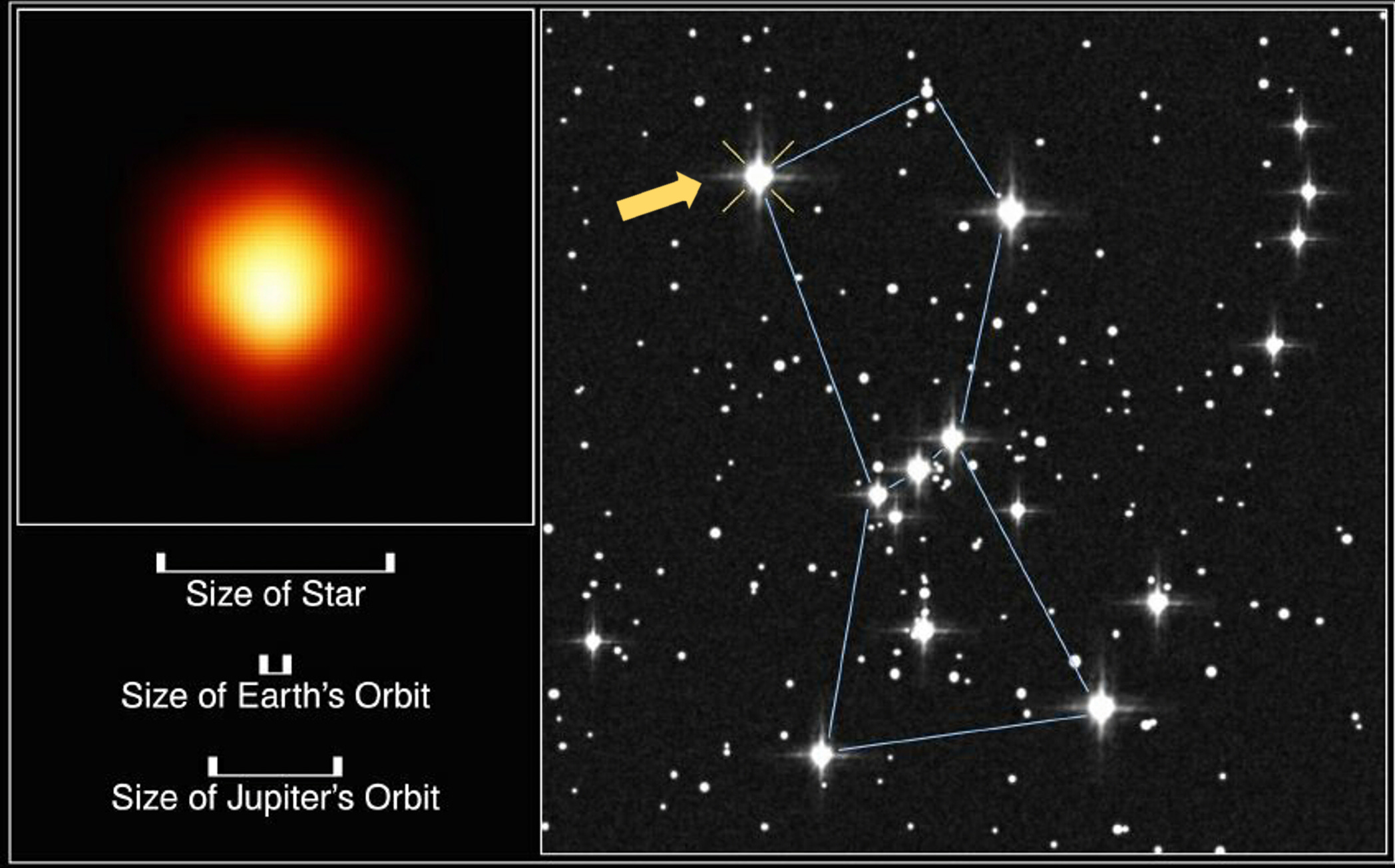
I want to tell you four things about that star. Each one is going to make it stranger than it was a second ago.
One. That star might not exist anymore.
Betelgeuse is roughly 550 light-years away. That means the light hitting your eye tonight left the star around the year 1475. Before Columbus sailed. During the late years of the Ottoman conquest of Constantinople. The photons currently bouncing off your retina have been traveling, in a straight line through the dark, for longer than the United States has existed. By a lot. (not trying to throw any shade)
And Betelgeuse is dying. It’s a red supergiant in the late, unstable phase of its life. It will go supernova. We don’t know when. Could be a hundred thousand years from now. Could have happened three hundred years ago and the news just hasn’t reached us yet. The light from that explosion is still in transit. We are, right now, in a 550-year information delay with this star. Whatever Betelgeuse is doing tonight, we won’t find out until sometime around the year 2576.
You’re not looking at a star. You’re looking at a photograph of a star. One that was taken five and a half centuries ago and is only just now finishing its delivery.
Two. You’re not standing still while you look.
This one is harder to feel. While you’re standing there in your garden or your balcony or the parking lot of wherever you happened to look up, you are moving.
The Earth is spinning under your feet. At the equator, that’s about 1,600 km per hour. While Earth is spinning, it’s also orbiting the Sun at around 107,000 km per hour. While Earth is orbiting the Sun, the entire solar system is moving through the galaxy at roughly 800,000 km per hour. And the galaxy itself, our entire Milky Way, is being pulled through space at over two million kilometers per hour, toward something astronomers literally call the Great Attractor because we’re not entirely sure what it is.
You are stacked on top of four motions, none of which you can feel, all of which are happening right now.
And at the center of all that motion, the thing the Sun is quietly orbiting at 800,000 km/h, is a black hole. Sagittarius A*. Four million times the mass of the Sun, sitting in the middle of our galaxy, and you are circling it at this exact moment. You have been circling it your entire life. You will circle it for every moment you have left.
Look at Betelgeuse again. You are not standing still. You are spinning, orbiting, drifting, and falling around a black hole, all at once, and somehow none of it shows up in your inner ear.
Three. The redness isn’t what you think it is.
A lot of people will tell you that red stars are moving away from us and blue stars are moving toward us. This is the Doppler effect, and it’s real, but not for what you’re seeing.
Betelgeuse is red because it’s cool. Around 3,500 Kelvin at the surface, compared to the Sun’s 5,800. Cooler stars glow redder; hotter stars glow blue. That’s it. The same reason an electric stove element glows red when it’s warming up and would glow blue-white if you could push it hot enough. Look at Rigel, Orion’s bottom-right corner. Bluish-white. That star is around 12,000 Kelvin. Hotter than the Sun by a lot. It’s not running toward you. It’s just on fire in a different way.
Real Doppler shift exists in the night sky, but it’s hidden. Distant galaxies, far past anything you can see with your eyes, are shifted toward red because the universe itself is expanding, stretching the light on its way to us. Every galaxy you can’t quite make out is running away from every other galaxy. The further it is, the faster it goes.
You can’t see this. You need a prism and some math.
That’s the part that gets me. The sky has information in it that your eyes physically cannot parse. There are facts about the universe written into the light hitting your face right now that you would need a spectrograph to read.
Four. And almost none of it is where it appears to be.
Betelgeuse is, more or less, where you’re pointing. The light traveled in a straight enough line, the star has barely drifted, and your finger is mostly honest.
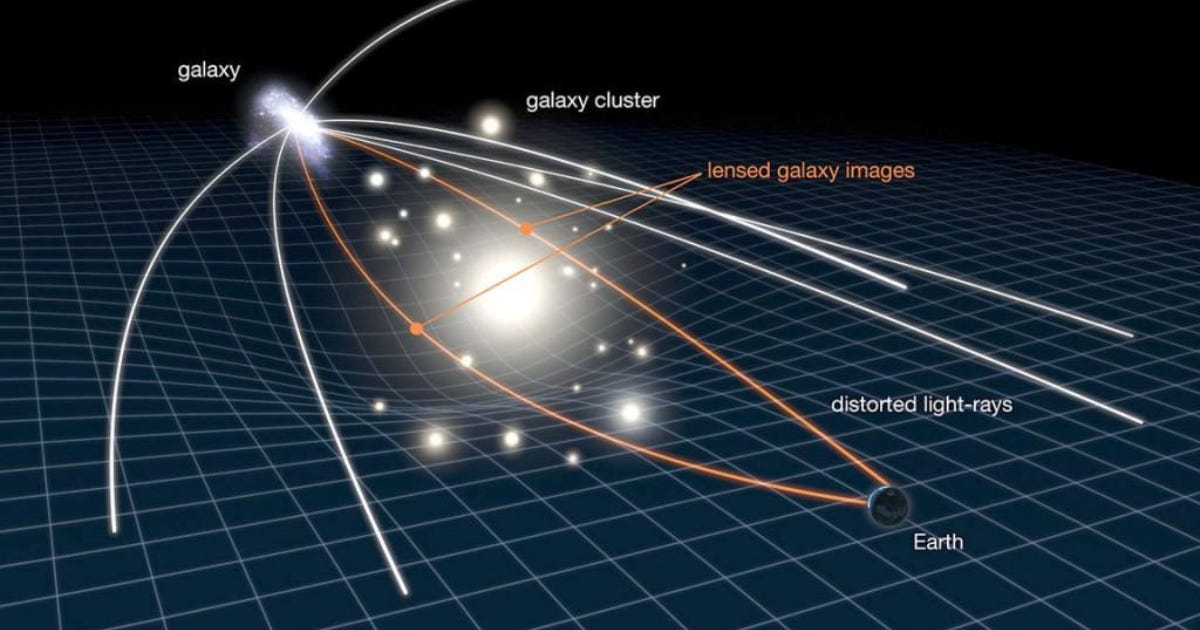
But for the faint things, the smudges that are actually distant galaxies billions of light-years away, your finger is lying. Light bends when it passes near massive objects. A galaxy cluster between us and a distant quasar will warp the path of the quasar’s light, sometimes splitting it into multiple images, sometimes smearing it into an arc. We call this gravitational lensing, and it means the position of the most distant things in the night sky is, in a real sense, a rumor. The light got rerouted on the way here.
The closer star is roughly where you think. The further you look, the less you can trust your own pointing.
So. You’re looking at a 550-year-old image of a dying star, while spinning under your own feet, orbiting a black hole at three-quarters of a million kilometers per hour, surrounded by light whose color is mostly temperature and partly motion you can’t see, with the most distant objects in your field of view sitting in places they aren’t.
I had a professor in university who said something I’ve never forgotten. He said: I have the honor of studying physics, and now when I look up at the sky, I know what’s actually happening. WOW.
I think about that “WOW” a lot. He earned it.
Physicists are poets sometimes.
Next time you look up, you’ll know too.
This Thursday, paid subscribers get Part 2, an actual guide to the night sky. What to find, when to find it, what each thing is, how to look. The kind of thing you can save on your phone for the next time you’re somewhere dark.
Your professor said it well! The whole part of looking back into time when we look up at the stars is the most awe-inspiring part of astronomy for me. Sometimes I look up a star's distance, go out and observe it, and think about what was happening in the world when the light I see tonight left that star.
Hell yeah, loved this article! Astronomy was my first love as a kid. I learned about the horsehead nebula in Orion and was instantly obsessed. I’ve often wonder whether Betelgeuse will go supernova in my lifetime. What a sight that would be. ✨💫