
Your Eye Slows Light Down
Two rival formulas for the momentum of a photon inside glass, water, and the vitreous of your own eye. They differ by a factor of nearly two. Both of them are correct.

There is a small violence in fundoscopy (Eyes imaging) that nobody warns you about in training. You dim the room, you get close enough to a stranger’s face that it stops being socially normal, and then you put a light into their eye and ask them please not to blink.
You are looking for the back wall. The optic disc, the vessels branching off it, whatever the years of pressure and sugar have quietly done to them.
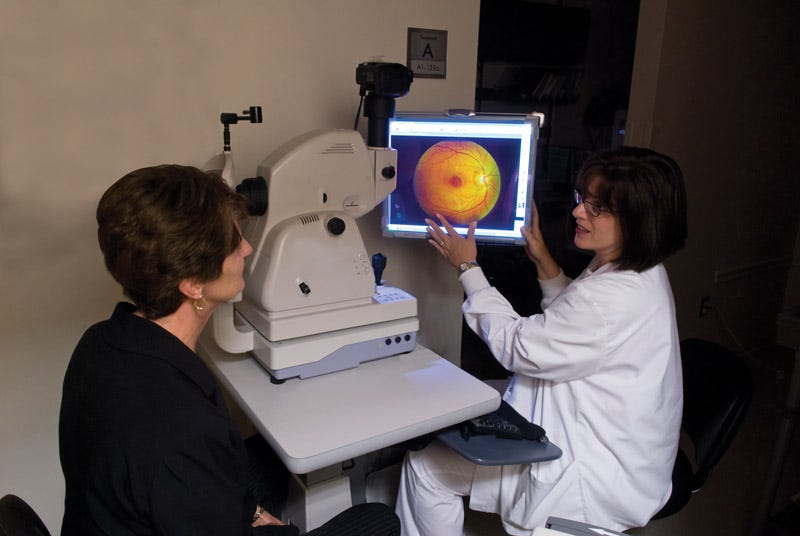
What you are doing, if you take the physics seriously for a second, is firing a stream of photons across four different materials in about a tenth of a nanosecond!
They meet the tear film, then the cornea, where the refractive index runs around 1.376 and the light drops immediately to roughly three quarters of its vacuum speed. Then the aqueous humour at 1.336. Then the lens, which is not one material but a gradient, near 1.386 at the cortex and 1.406 at the nucleus. Then the vitreous, back down to 1.336. Then the retina, where the whole trip ends in a molecule bending out of shape.
Monday’s letter was about the fact that light pushes on things at all. Momentum equal to energy divided by the speed of light, mass or no mass, a poppy seed’s worth of force spread across your whole body every daylight hour, real and permanently below your threshold of feeling.
I left something out of it.
That formula, p = E/c, is a vacuum formula. The moment your light enters that cornea it is no longer in a vacuum, and the question of how much momentum it is carrying turns into one of the longest running arguments in the history of the subject. It ran for a hundred and two years. It involved a mathematician who died before the argument he started got properly going, a physicist who spent his career picking fights with Einstein, and roughly a dozen careful experiments that kept contradicting each other without any of them being wrong.
I did not know any of this month ago. I want to walk you through it in the order I found it, because the order is what made it land.
Two men, one year apart
Hermann Minkowski published his version in 1908. If you know the name it is probably from spacetime, the four-dimensional geometry he built out of Einstein’s relativity, the thing that made Einstein’s algebra into a shape. Momentum of light in a medium was a smaller item on a long list.
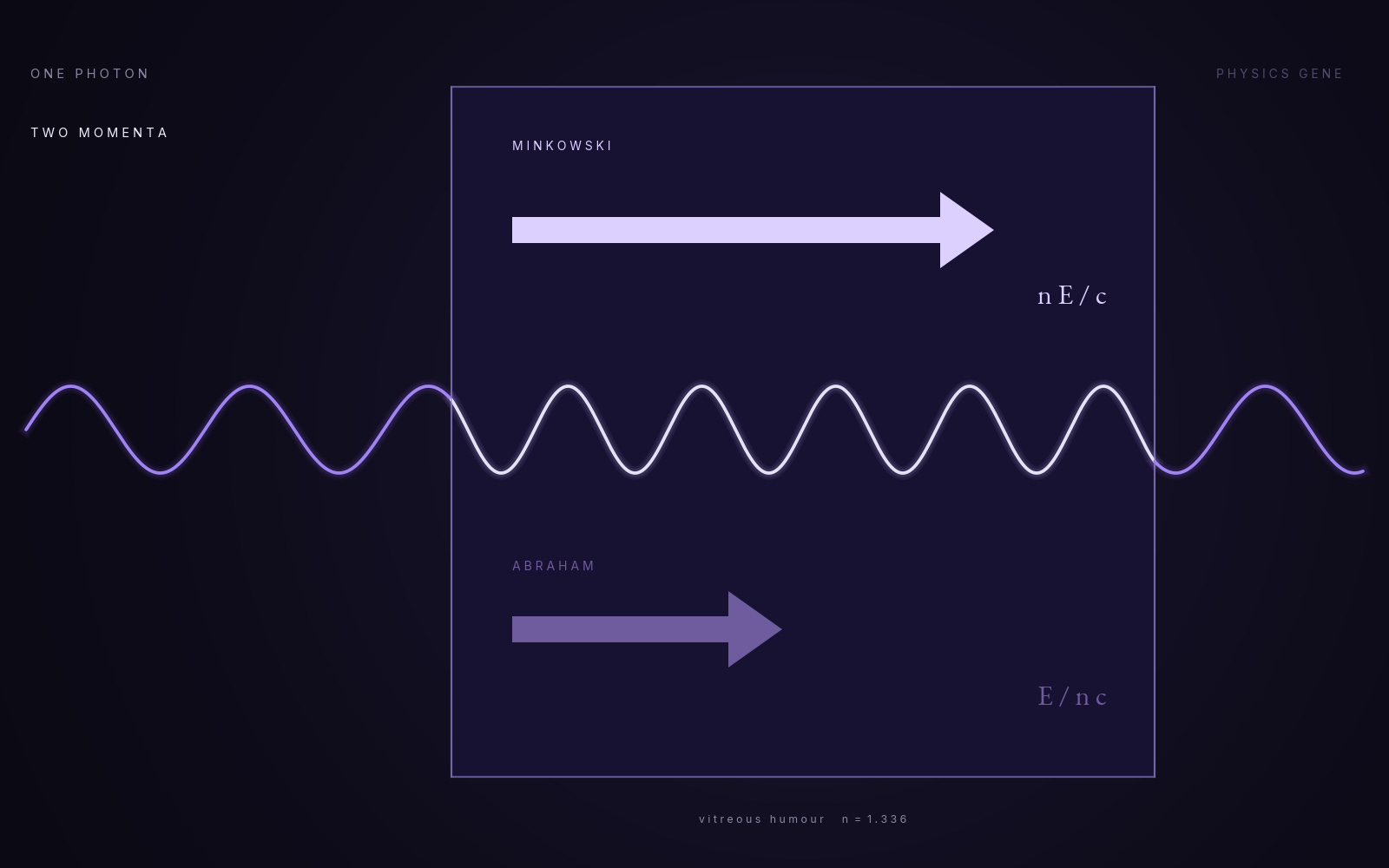
His answer: the momentum goes up. Multiply the vacuum value by the refractive index.
p = nE/c
And there is something immediately reasonable about that, which you can see without any machinery. A wave that slows down while its frequency stays fixed has to shorten its wavelength. Light entering the cornea at 1.376 has its wavelength squeezed by that same factor. De Broglie’s relation says momentum is Planck’s constant divided by wavelength. Shorter wavelength, larger momentum. The light gets stiffer as it enters you.
Max Abraham published his the following year, 1909. Abraham is a less comfortable figure. He spent years attacking special relativity, backed a theory of the electron that turned out to be wrong, and Einstein wrote about him afterwards with real affection anyway, the way you might about a rival who at least never bored you.
His answer was the opposite. The momentum goes down. Divide by the refractive index.
p = E/(nc)
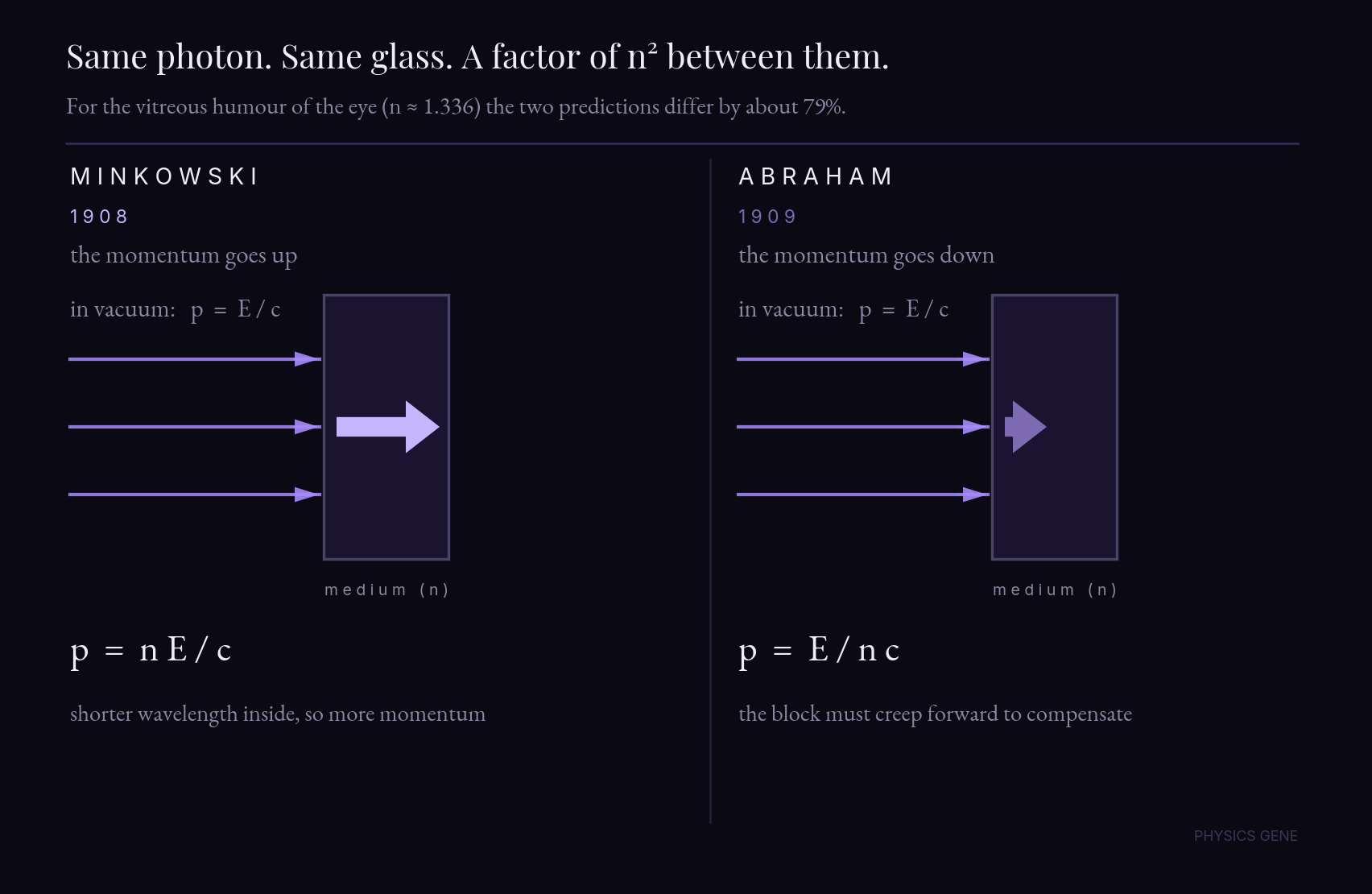
Notice what this means. For the vitreous humour at 1.336, the two predictions differ by a factor of n squared, which is about 1.79. Nearly double. This is not a rounding disagreement or a second-order correction. Two formulas from two serious people, differing by almost a factor of two, about the momentum of ordinary light inside ordinary water.
And for forty-five years nobody could break the tie, because both arguments are load-bearing.
Why you cannot simply pick one
The strongest case for Abraham is a thought experiment from 1953, by a Hungarian-American physicist named Nándor Balázs, and it is the kind of argument that makes you slightly angry with how clean it is.
Float a transparent block in deep space. Nothing touching it, nothing pulling on it. Send a single pulse of light through it, in one face and out the other, no reflection.
Inside the block the light travels at c/n, slower. So it comes out later than it would have if the block had not been there, and therefore further back than it would otherwise be. The pulse has fallen behind.
But the centre of mass of an isolated system has to keep moving uniformly. That is not a rule about light, it is Newton’s first law with Einstein’s mass-energy equivalence bolted on, and if it fails then everything fails. The light carries energy, energy carries inertia, and the light’s share of the system’s centre of mass has just lagged.
Something has to make up the difference. The only candidate is the block. So while the pulse is inside it, the block must creep forward.
Work out how much momentum the block has to have acquired to creep exactly that far, subtract it from the total, and what remains for the light is E/(nc). Abraham’s value, arrived at using nothing but conservation of momentum and the uniform motion of a centre of mass.
Barnett and Loudon, reviewing the whole mess in 2010, put it plainly: it is difficult to see how any component of that derivation could seriously be open to question.
Now the case for Minkowski, which is just as bad.
Take an atom sitting inside a medium, moving away from a light source, and let it absorb a photon. The absorption only happens if the Doppler-shifted frequency matches the transition. Write down conservation of energy, write down conservation of momentum, solve for the photon’s momentum. Out comes nE/c. Minkowski’s value, from the Doppler effect and two conservation laws.
Or take a slit. Send light through a narrow slit and it diffracts, and the angular width of the central peak is fixed by the uncertainty principle: narrow the slit, spread the momentum sideways. Do the same experiment submerged in a medium and the peak comes out narrower by exactly n. The slit has not changed, so the sideways momentum spread has not changed. The only way the angle shrinks is if the forward momentum grew by n.
So to throw out Abraham you have to throw out Newton’s first law. To throw out Minkowski you have to throw out the uncertainty principle, or the Doppler effect, or conservation of momentum.
Physics had two answers, differing by a factor of two, each resting on something nobody was willing to give up.
So they went and measured it
This is the part that got me, and it is why I wanted to write this one for you rather than post it as a note.
1954. R. V. Jones and J. C. S. Richards hang a mirror in a liquid, shine light on it, measure the pressure. The force scales with the refractive index. Minkowski.
1973. Arthur Ashkin, the same man whose optical tweezers ended Monday’s letter, focuses a pulsed laser on the free surface of pure water with James Dziedzic. Sixty nanosecond pulses, four kilowatts of peak power, a spot about two microns across. The water surface bulges outward, roughly a micron of it, enough to act as a lens. They read it as Minkowski, though this one has been argued over ever since, and Gordon published a challenge to the interpretation the same year.
1975. Walker, Lahoz and Walker measure the force on a barium titanate specimen in crossed fields. Abraham.
1978. Jones again, now with Leslie, better apparatus, dispersive media. Minkowski.
1980. Gibson and colleagues push far-infrared light through germanium and silicon and watch the momentum land on the free charge carriers. Minkowski.
1994. Kristensen and Woerdman measure the torque on an object inside a dielectric, the angular momentum version of the same fight. Minkowski.
2005. Campbell and Ketterle’s group at MIT measure the recoil of atoms inside a Bose-Einstein condensate, which is about as clean as this experiment can be made. Minkowski.
2008. She, Yu and Feng watch light leaving the end face of a silica filament a few hundred nanometres wide and measure which way the fibre bends. Abraham.
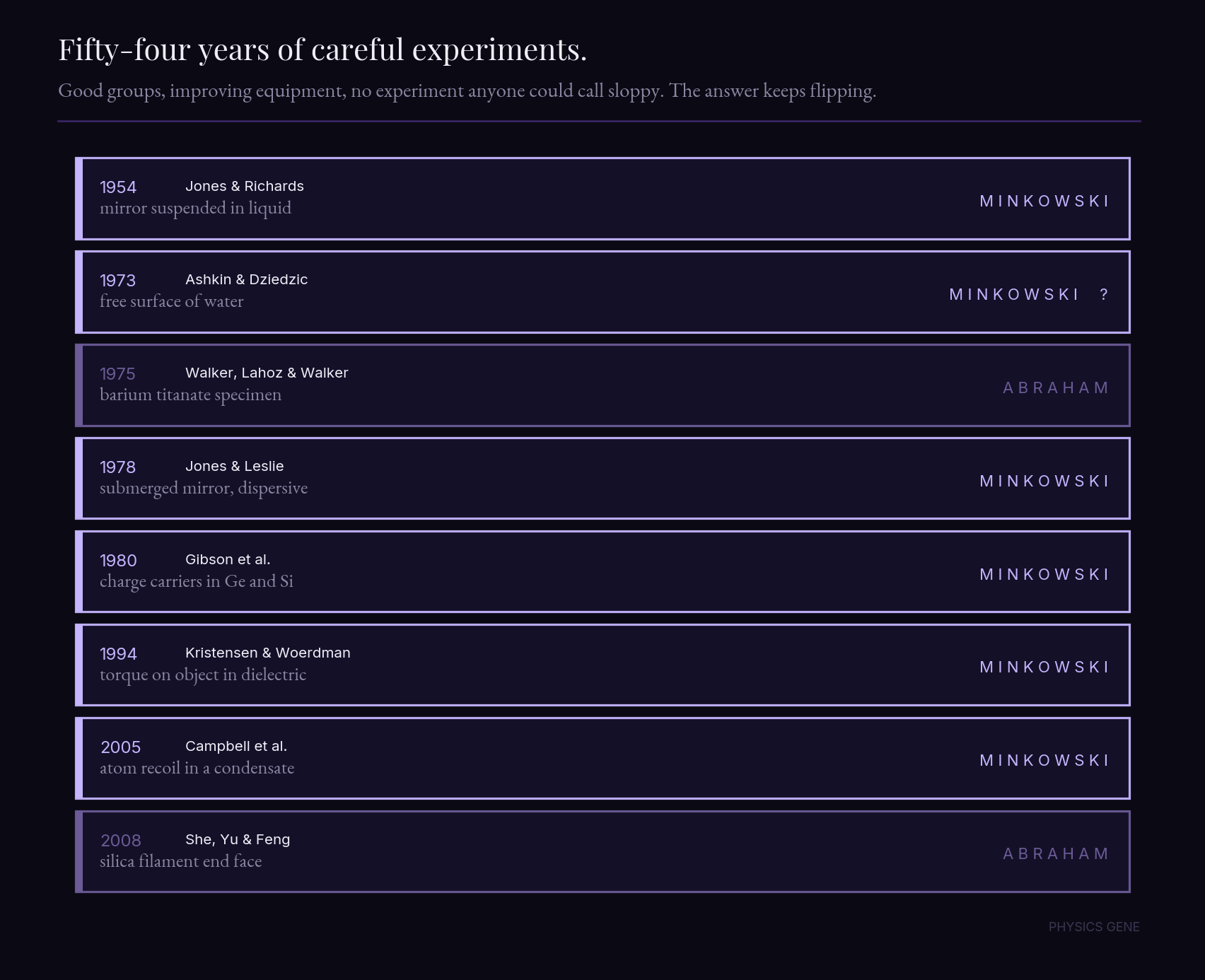
Half a century of it. Good groups, improving equipment, no obvious pattern, no experiment that could be dismissed as sloppy, and the answer flipping back and forth like a coin that will not settle.
Somewhere in that list is a pattern.
It has nothing to do with who had better vacuum pumps or which decade you were working in. Sort those experiments by what each one was physically touching, and the disagreement evaporates. Every single one falls into line, including the two that went to Abraham, including the contested one in 1973.
It took a hundred and two years for anyone to sort them that way. And when somebody finally did, the answer was not that Minkowski won, or that Abraham won, or that the truth sat somewhere in the middle at an average of the two.
The answer was that the word momentum has been quietly doing two separate jobs since Newton, and no experiment in the history of physics had needed anyone to notice, because the two jobs give identical answers everywhere except inside a piece of glass.
Below: the sorting rule, the 2010 paper that found it, what the two momenta actually are and why you already know one of them, the calculation where the total comes out as the exact average of Abraham and Minkowski, and what any of this means for the photon crossing your patient’s vitreous while you are squinting at their optic disc.
Keep reading with a 7-day free trial
Subscribe to Physics Gene to keep reading this post and get 7 days of free access to the full post archives.