
Sunlight Weighs Nothing and Pushes You Anyway
Every photon lands with a measurable shove. There are spacecraft that sail on nothing but this.

There is a kind of afternoon in August here when the sun stops behaving like light and starts behaving like weather. You step out of a building and something arrives on your face and your shoulders, and the most natural word for it is pressure.
That word is doing something slightly dishonest, and I want to spend a Monday on why.
What you are feeling is heat. Your skin absorbs infrared, the temperature of the tissue climbs by a fraction of a degree, and the thermoreceptors sitting underneath start firing. Your brain reads that firing as intensity, and intensity is very easy to mistake for force. It is the same trick your hand plays on you when a metal railing in that sun feels violent to touch and the wooden bench beside it feels fine, even though a thermometer would tell you the two are at exactly the same temperature.
So the pressing sensation is mostly a story your nerves are telling you.
There is a real push underneath it, though. It has been there every second you have ever stood in daylight, it has been measured to several decimal places, and it sits so far below your detection threshold that no human being has ever felt it or ever will.
Light has no mass, and that turns out to be beside the point
Momentum, in the version most of us were handed at school, is mass times velocity. If that is what momentum is, then a photon has none of it, because a photon has no rest mass, and zero multiplied by anything stays zero.
The trouble is that p = mv was never the definition. It is a special case that works beautifully when things are slow and heavy, which happens to describe almost every object you have ever picked up. The fuller relationship is the one relativity gives us:
E² = (pc)² + (mc²)²
Set the mass to zero and the second term simply disappears. What survives is:
E = pc, which rearranges to p = E/c
Momentum equals energy divided by the speed of light, and mass never enters the conversation at all. Its absence does not cancel the momentum. Its absence just deletes a term that was sitting next to it.
I keep running into this pattern and it still gets me. A formula you were given as a definition turns out to be the shadow of a bigger one, and the result you find impossible was hiding inside the approximation the entire time.
How hard, exactly
On a clear day at noon, roughly a thousand watts of sunlight land on every square metre of ground. Divide by the speed of light:
1,000 ÷ 300,000,000 ≈ 3.3 millionths of a pascal
Now stand a square metre of yourself in front of it. That is about three millionths of a newton, which is the weight of a poppy seed. One poppy seed, resting across your whole chest and shoulders, every daylight hour of your life.
You cannot feel it and the reason is anatomical rather than physical. The mechanoreceptors in your skin need force concentrated on a point, and they need orders of magnitude more of it than this, before a single one of them will fire. Sunlight is delivering a smaller load than that, smeared evenly across your entire surface. There is nothing for the nerve to grab onto.
Scale the same arithmetic up and it stops sounding negligible. Earth turns a disc of about 128 trillion square metres toward the Sun, so the total force of sunlight on this planet runs to something close to 600 million newtons, pushing us gently outward, permanently. Which is an enormous number until you put it beside the Sun’s gravitational grip on us and find that light is losing that particular contest by a factor of around sixty trillion.
Nobody was going to notice this by feel. It had to be reasoned into existence first, and then chased.
Kepler noticed something in 1619
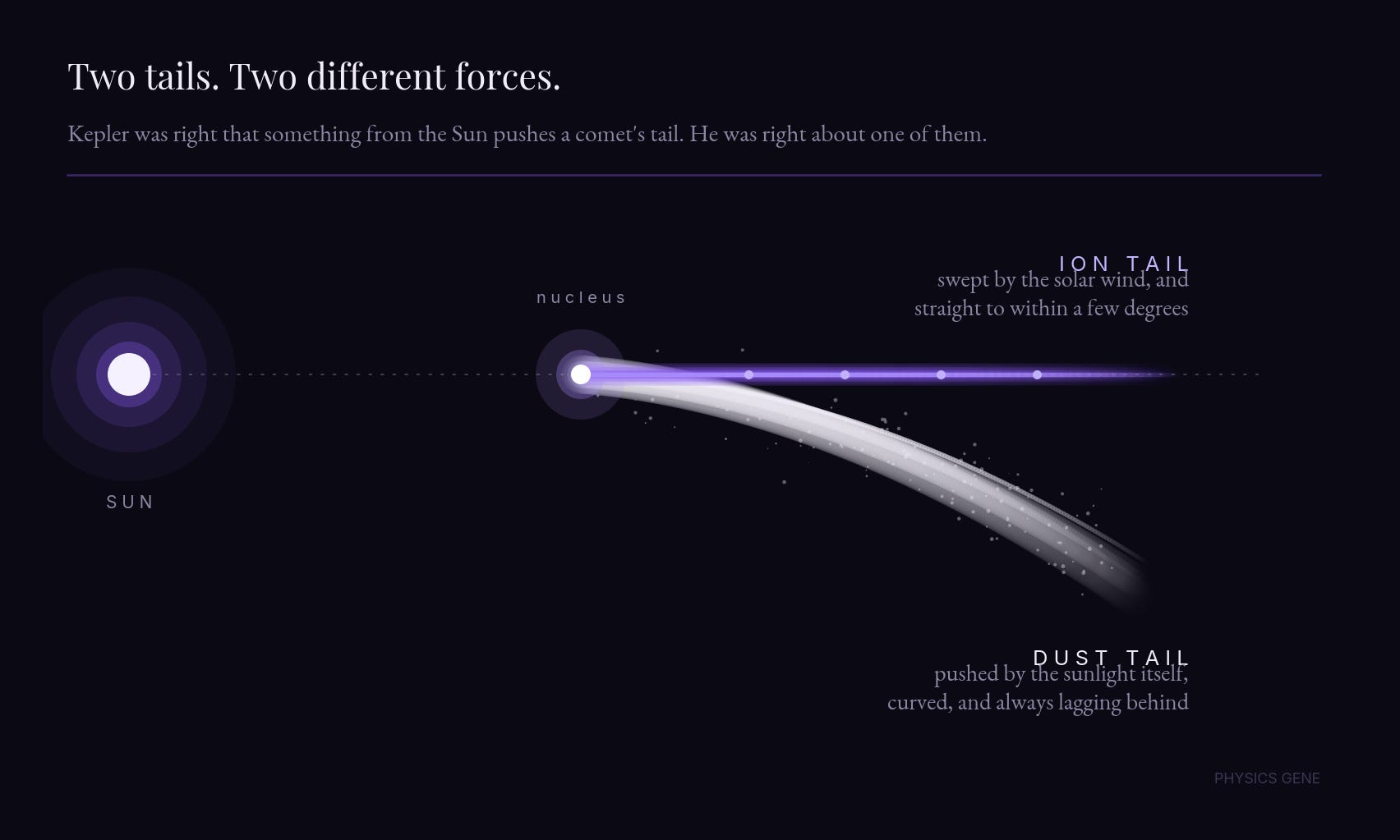
He was looking at comets, and he could not get past one detail: the tail never trails behind the comet the way smoke trails behind a train. It points away from the Sun. When the comet swings around and heads back out, the tail goes in front of it. Whatever is making that tail is being pushed, and the push is coming from the direction of the Sun.
Kepler’s guess was sunlight. He wrote it down two and a half centuries before anyone could justify it.
Here is what I did not know until recently, and what makes the story better rather than worse. A comet has two tails, and Kepler was right about one of them.
The dust tail is genuine radiation pressure. Sunlight pushes on grains of released silicate dust, and because those grains stay in their own slightly altered orbits around the Sun, that tail comes out broad, pale and curved, always lagging behind the comet’s path.
The other one, the narrow blue tail that points almost exactly away from the Sun, is not light at all. In 1951 Ludwig Biermann worked out the accelerations in those tails and found them roughly a thousand times too large for sunlight to be responsible. Something else had to be doing it. What he proposed to fill the gap was a continuous stream of charged particles pouring off the Sun, and that proposal is how we came to know about the solar wind.
Kepler pointed at a comet and said the Sun is pushing that. He was correct twice over, and wrong about which mechanism was doing which job, and one of the two answers took another three hundred and thirty years to arrive.
Maxwell predicted it, then refereed the paper that got it wrong
Maxwell’s electromagnetism gave the push a firm theoretical footing in 1873. Light carries energy and momentum, so light presses on whatever it lands on. The number was small but it was no longer a guess.
That same year, the chemist William Crookes built a little glass bulb with four vanes inside, each blackened on one face and silvered on the other, partially evacuated. Put it in sunlight and the vanes spin. Crookes announced he had demonstrated the pressure of light directly, on a tabletop, for anyone to see. Maxwell refereed the paper, and by the accounts I have read he was pleased to see his prediction apparently made visible.
The device is wrong, and it is wrong in a way that is more interesting than if it had simply failed.
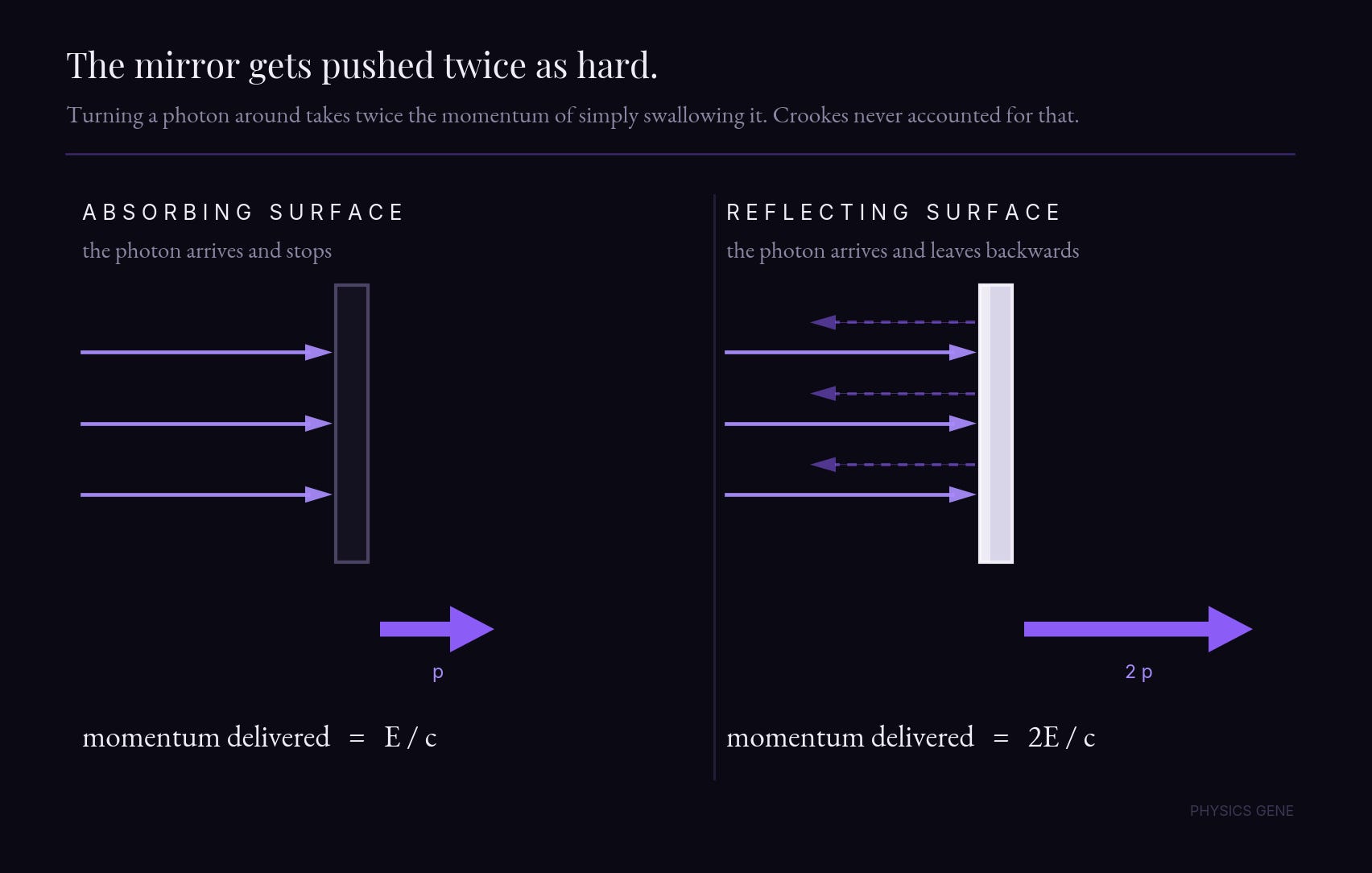
A photon absorbed by the black face delivers its momentum, E/c, and stops. A photon striking the silver face bounces back the way it came, which means it has to be turned all the way around, which takes twice the momentum. So radiation pressure is twice as strong on the mirrored side. If light were driving that toy, the black faces would lead and the silver faces would trail.
They do the opposite. Every one of them. Crookes had built a beautiful demonstration of something else entirely.
The actual mechanism is the residual gas in the bulb. The black face runs hotter, and around the edges of each vane, gas creeps from the hot side toward the cold one and shoves the vane the other way. Osborne Reynolds identified the effect. Maxwell refereed Reynolds’ paper too, immediately saw further into it than Reynolds had, and wrote up the mathematics himself in a paper that appeared in the Philosophical Transactions in 1879 and turned out to be the last major work he ever published. He died that November.
There is something I find hard to sit with about that sequence. Maxwell predicted radiation pressure, approved a demonstration of it that was measuring the wrong thing, and then, in the final months of his life, wrote the paper explaining why his own prediction was not what the famous toy was showing.
The real measurement took another twenty years and had to be done in a much harder vacuum, on vanes hanging from fine fibres, with every thermal effect hunted down and eliminated. Pyotr Lebedev did it first in Moscow and reported it in 1900. Ernest Nichols and Gordon Hull did it independently at Dartmouth and published in 1901, and again more precisely in 1903, unaware of Lebedev until afterwards. The push was real, and it matched Maxwell to within the error bars.
Then somebody built a sail
If the force is constant and you have nowhere to be, small stops mattering. There is no fuel to run out of.
JAXA launched IKAROS in May 2010, riding along with the Akatsuki mission to Venus. It unfurled a square of polyimide film fourteen metres on a side, about two hundred square metres of sail, by spinning and letting the weights at the corners pull it open. In July, tracking the craft by Doppler, the team measured the thrust that sunlight alone was producing on it.
1.12 millinewtons. Roughly the weight of a large grain of rice, applied to a 310 kilogram spacecraft.
That works out to an acceleration of about three millionths of a metre per second squared, which is nothing, until you remember it never switches off. Keep pushing at that rate for a year and you have added something like a hundred metres per second to your velocity, without carrying a gram of propellant. In 2019 the Planetary Society’s LightSail 2 became the first small spacecraft to change its own orbit using sunlight and nothing else.
The part I keep coming back to
By 1986, Arthur Ashkin at Bell Labs had worked out how to focus a laser tightly enough that the radiation pressure would hold a small particle at the focus instead of blowing it away. He called them optical tweezers. In 1987 he used them to pick up a tobacco mosaic virus, and then an E. coli.
His first attempts killed the cells. Visible laser light at the powers he needed was absorbed by the water and the cell contents, and the bacteria cooked, and some of them burst. He switched to infrared, which water barely absorbs, and the problem went away. The trapped cells stayed alive. He watched them divide inside the beam.
The forces involved are piconewtons, a millionth of the poppy seed on your shoulders. But an E. coli weighs about a picogram, and against that, a few piconewtons is hundreds of times the bacterium’s own body weight. The force did not get bigger. The thing being held got small enough for the force to matter.
I have been thinking about that ratio for weeks. The same push that cannot make itself known to a single nerve ending in your skin can lift a living cell off the floor of a dish and hold it in mid-water for hours. It is the same equation both times. It is only ever the same equation. Ashkin got half the Nobel Prize for it in 2018, at ninety-six years old.
I will admit the thing I have not resolved. I can do the algebra that says a massless particle carries momentum, and I have done it enough times that it comes out automatically now. That is not the same as understanding it, and I do not think I understand it. When I try to picture what is actually being handed over when a photon strikes a mirror, I get nothing back. Possibly there is no picture and the equation is the whole of it. Possibly wanting a picture is a hangover from being an animal that grew up throwing rocks. I have not decided which of those is the honest answer, or whether they are the same answer wearing different clothes.
Either way, you are being pushed. Slightly. Continuously. Right now, if you are reading this near a window.
Fun! If you watch For All Mankind, a photon sail is used to get NASA to Mars.
Speak for yourself. Sunlight has felt like it was pushing on me my whole life.