
Gravity Is Not a Force
The whole story, from Newton to Einstein and why the most famous picture in physics can't be true.

You’ve seen it. A bowling ball sitting in the middle of a stretched rubber sheet, the surface sagging into a smooth funnel around it, a few marbles circling the dip like little planets.
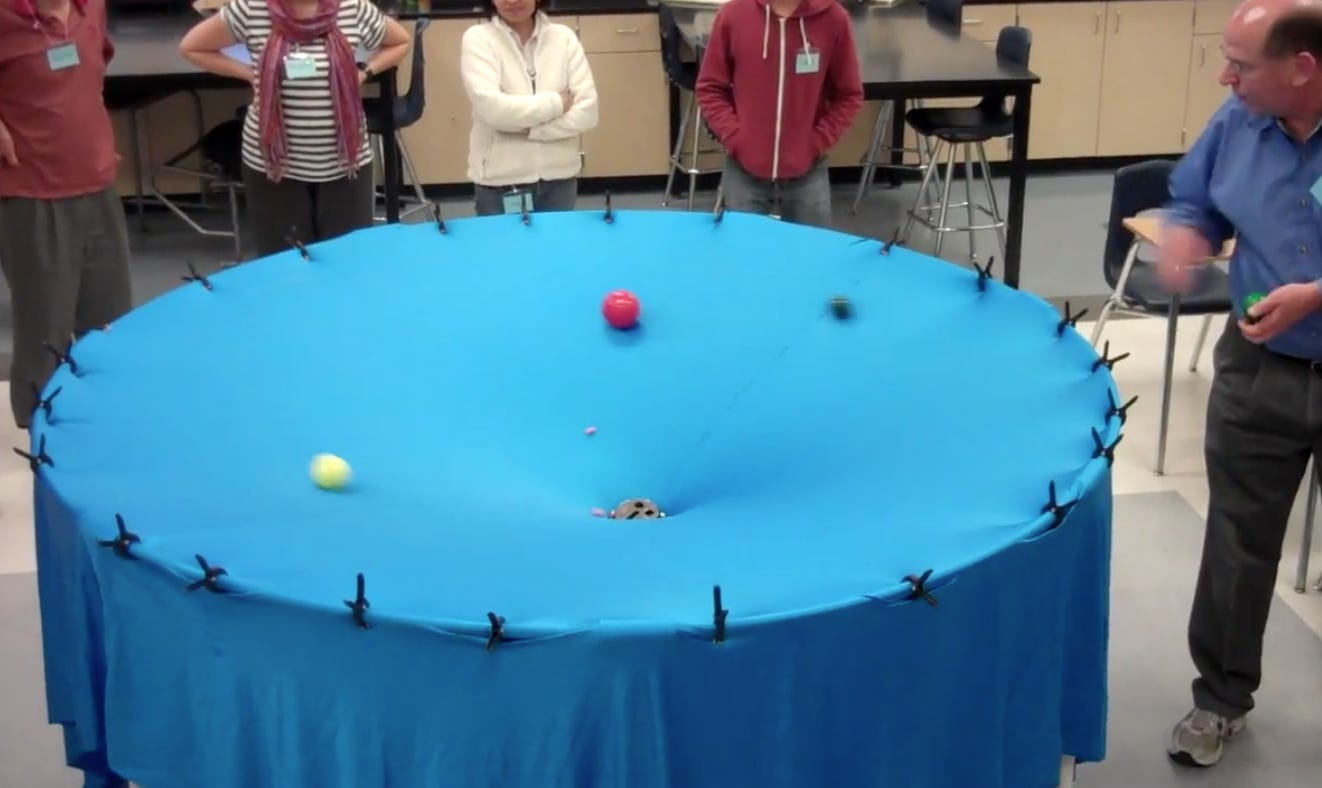
Maybe it was a textbook. Maybe it was a science video with dramatic music. Either way, the caption was the same:
This is gravity. Gravity is not a force. It’s the curving of spacetime.
And that sentence is true. Genuinely, beautifully true, one of the deepest things our species has ever worked out.
These pictures, though? I don’t know about that.
By the end of this you’ll see exactly why, and you won’t be able to look at that rubber sheet the same way again.
But as always, the story is better than the journey. And our story is with a man who got gravity so right we used his answer to land on the Moon, and still, somehow, got it completely wrong.
In 1687, Isaac Newton published the law of universal gravitation. (He’d worked the idea out decades earlier, in his twenties, during the plague years ,but 1687 is when he wrote it down properly, in the Principia.
The idea is stunningly simple. Every mass attracts every other mass. The bigger the masses, the stronger the pull. The farther apart, the weaker, and it weakens fast, with the square of the distance.
That one line predicts the orbit of the Moon, the arc of a thrown ball, the ocean tides, the return of a comet decades before it arrives. It was the single most successful equation in the history of science. For two hundred years, gravity was a closed case.
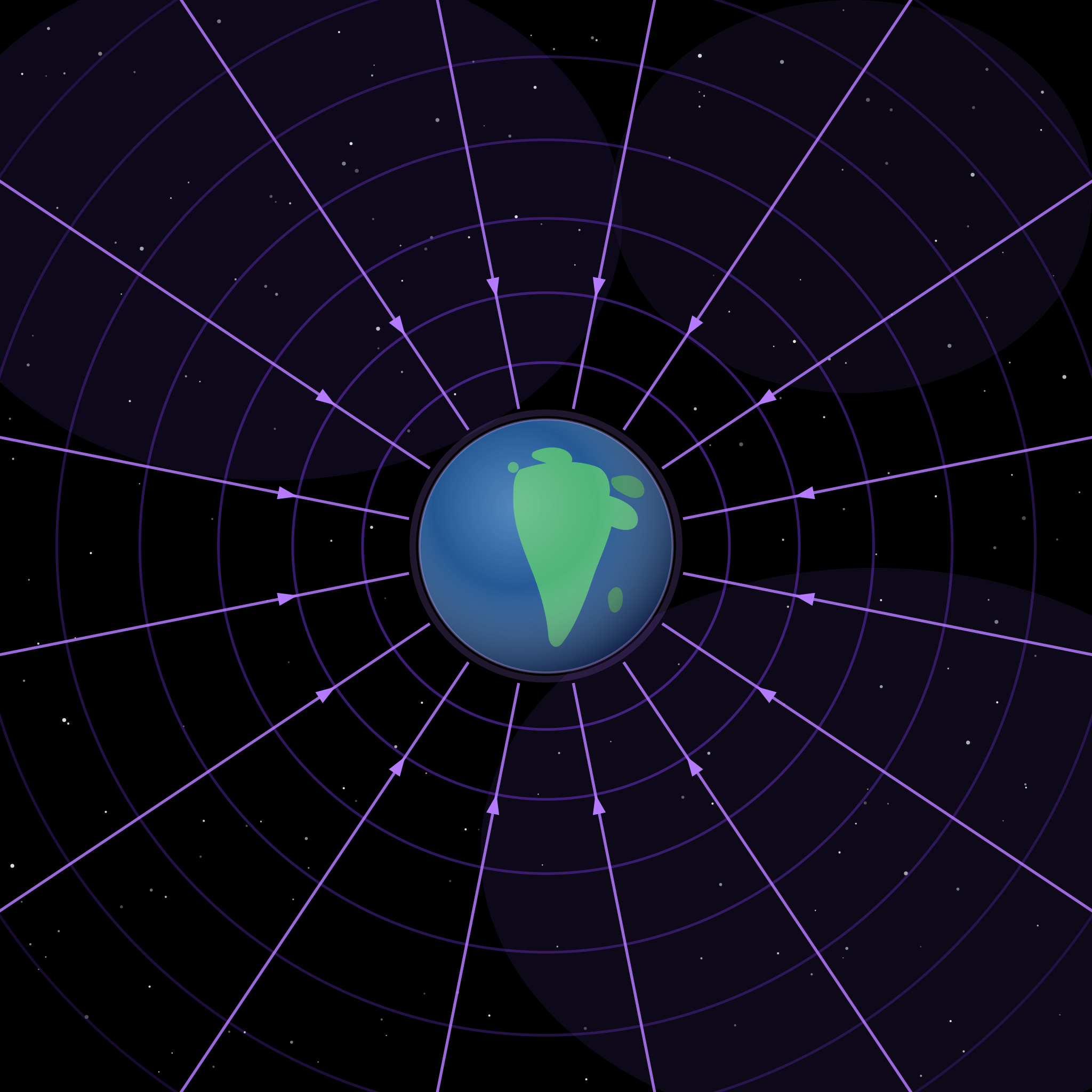
Here’s how Newton pictured it. A mass, let’s say the earth, creates a field of attraction around itself. Anything with mass that wanders into that field feels a pull toward the Earth. The Moon feels it. An apple feels it. You feel it right now, holding you down in your chair.
If “a field of attraction” sounds vague, you already know a sharper version of the same idea, even though it was discovered a full century later.
The clearer cousin: electric charge
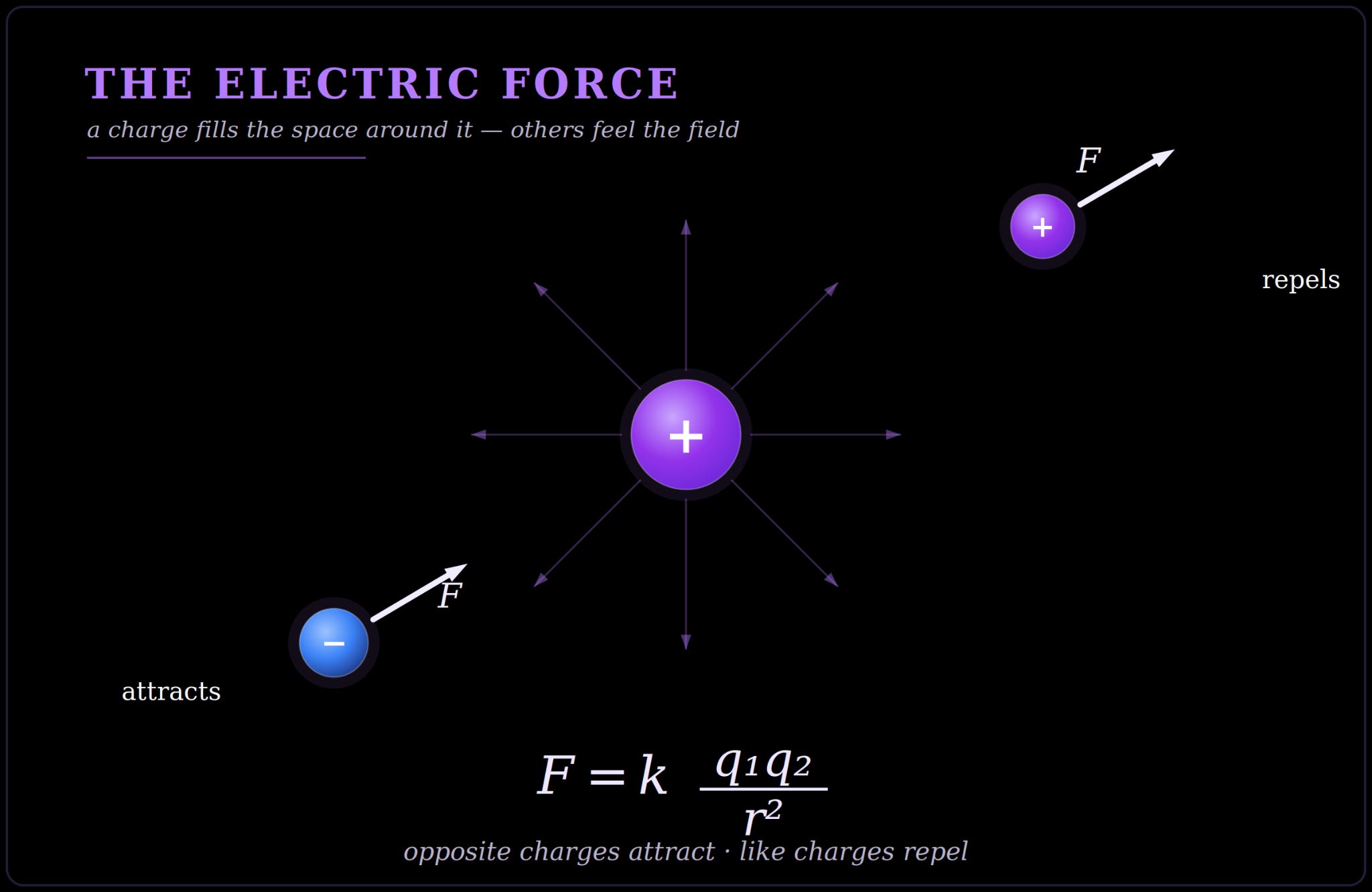
A charged particle creates an electric field around it. Drop another charge into that field and it feels a force. Opposite charges pull together; like charges push apart. The math is almost a carbon copy of Newton’s, a property of one object (charge), creating a field that other objects feel across empty space, dying off with the square of the distance.
Now slow down on one detail, because it turns out to matter far more than anyone realized at the time.
Electric charge comes in two flavours, and it can both attract and repel. Mass comes in one flavour only.
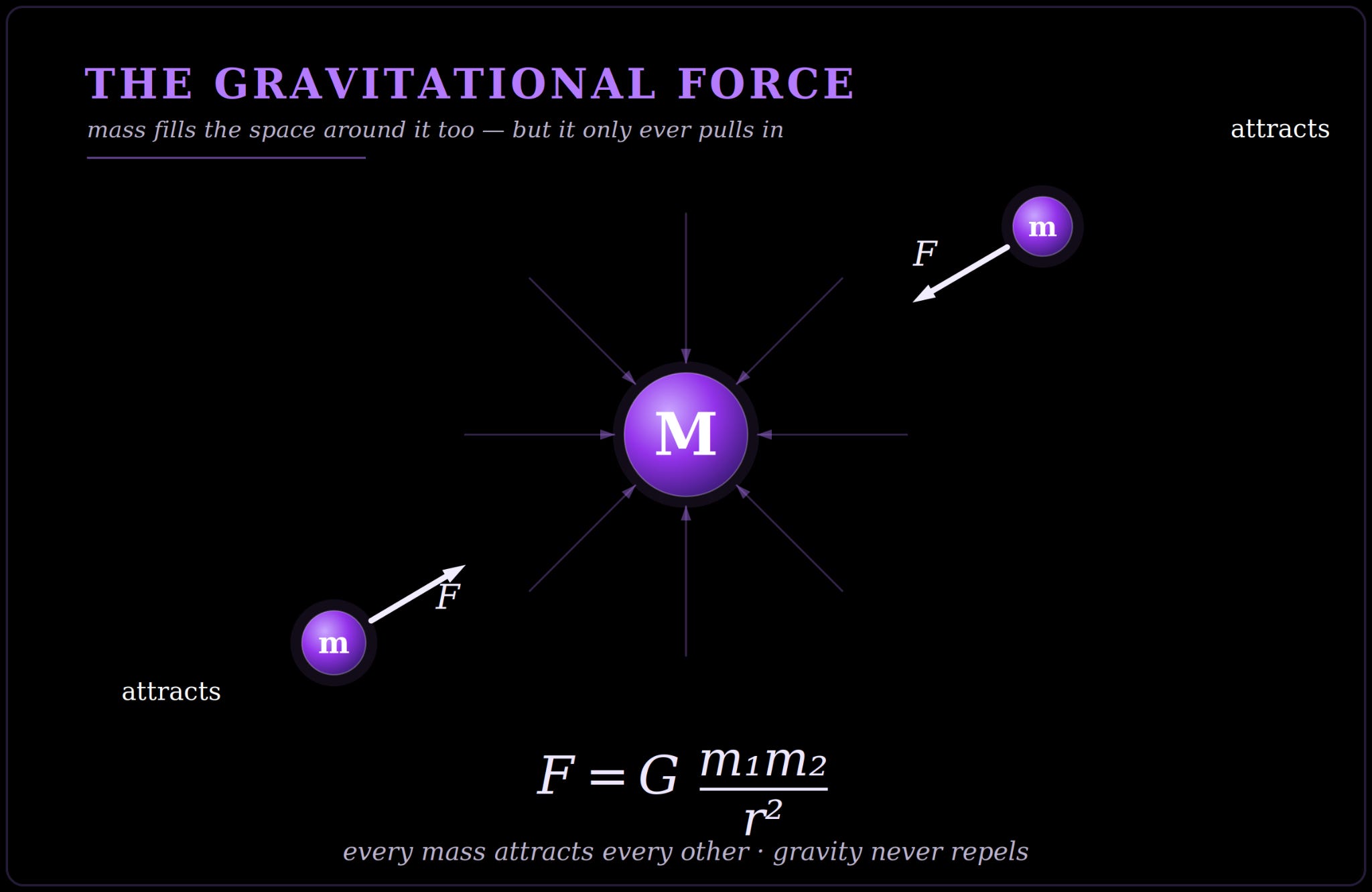
Mass only ever attracts. There is no anti-mass that pushes you away, no negative weight, no gravitational repulsion anywhere in the universe. Everything pulls everything else, always inward, never out.
Hold onto that. Gravity only attracts. It’s a quiet little asymmetry, and it’s the first hairline crack in Newton’s beautiful machine.
The cracks
Because for all its success, Newton’s gravity had a problem that bothered even Newton himself.
How does the pull actually get there?
The Sun reaches across 150 million kilometres of empty space and holds the Earth in its orbit. Through what? There’s nothing in between. Newton had no mechanism, just a formula that worked flawlessly. He flatly refused to even guess at the cause. The force simply acted, instantly, across any distance, through nothing at all.
And “instantly” is where the whole structure eventually gives way.
In 1905, a twenty-six-year-old patent clerk named Albert Einstein published special relativity, and one of its hardest rules is this: nothing in the universe, no object, no signal, no influence of any kind, can travel faster than light. Not even the news of a force.
But Newton’s gravity is instantaneous. In Newton’s universe, if the Sun vanished right now, the Earth would feel it this same instant and fly off into the dark, no delay, infinitely faster than light.
Both cannot be true. Either light speed is the cosmic limit, or gravity is instant. Einstein had just staked his entire reputation on the speed of light. So gravity had to bend to fit. He spent the next ten years bending it.
The happiest thought
The breakthrough didn’t come from mathematics. It came from a daydream.
Einstein later called it “the happiest thought of my life.” It was this: a person in free fall — off a roof, out of a plane — does not feel their own weight. In the moment of falling, gravity simply vanishes. You feel nothing. You float. (You’ve tasted a sliver of this at the crest of a roller-coaster drop, in the half-second your stomach floats up to meet you.)
Sit with how strange that is. Gravity is supposedly a force pulling on you every second of your life. Yet the instant you stop resisting it — the instant you let it have you completely — the feeling of it disappears entirely. What kind of force switches off the moment it becomes the only thing acting on you?
And it cuts the other way too. Seal a person in a windowless box. If the box rests on the Earth, they feel their normal weight. Now haul that same box into deep space, far from any planet, and accelerate it upward at just the right rate. The person inside feels... exactly the same weight. Standing on a planet and accelerating through empty space are indistinguishable. There is no experiment they could run inside that box to tell which one is happening.
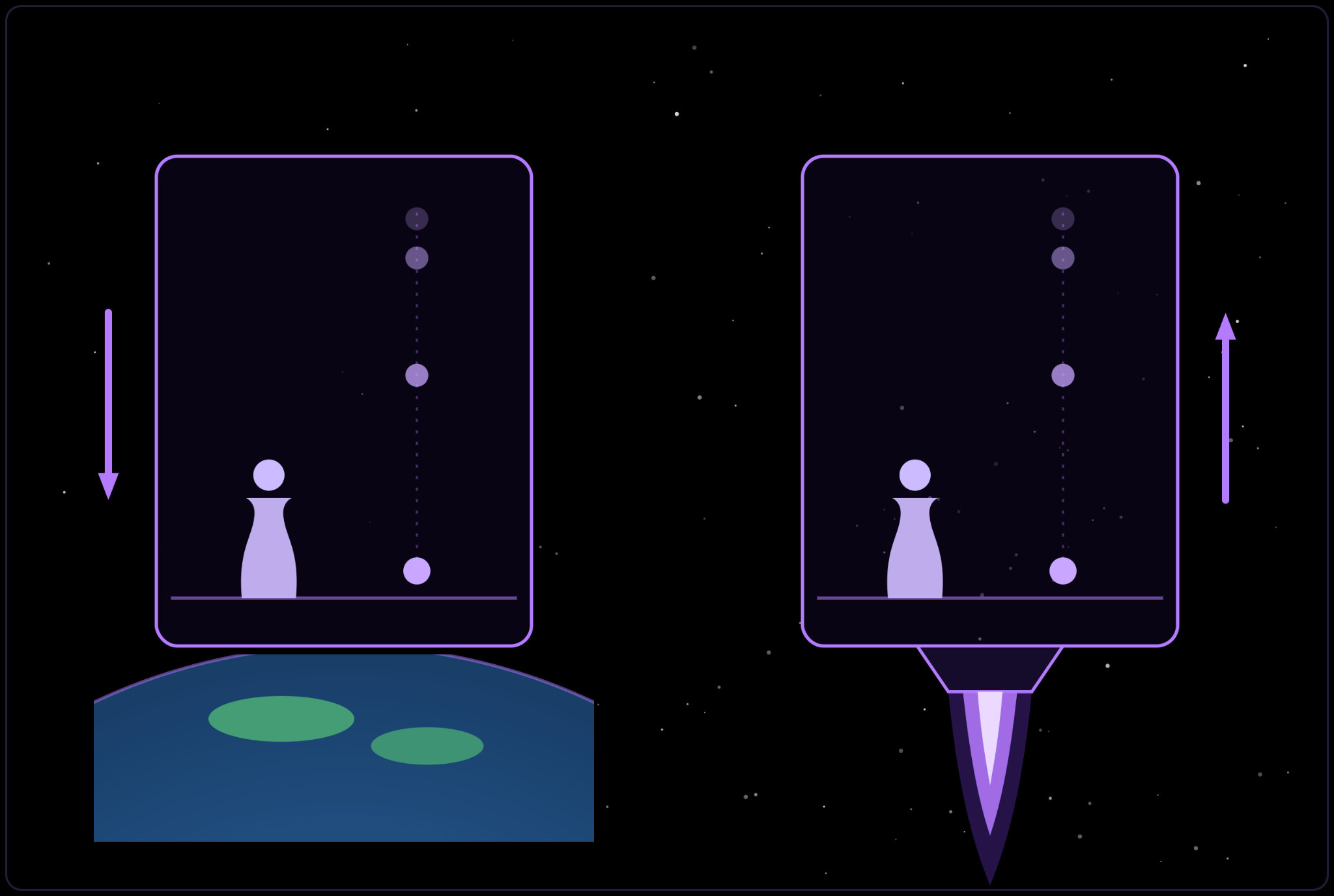
This is the equivalence principle, and folded inside it is the clue that cracks the whole problem open.
The leap
Why does everyone in a falling elevator float, no matter their size or weight? Why does a feather fall at the same rate as a hammer in a vacuum, something an astronaut actually demonstrated, for real, standing on the Moon? In Newton’s world this is a bizarre coincidence: heavier things are pulled harder, but they’re also harder to get moving, and the two effects cancel perfectly, every time, for every object ever tested.
Einstein refused to accept it as a coincidence. He saw what it was quietly telling us:
If every object falls in exactly the same way regardless of its mass, then falling isn’t a fact about the object at all. It’s a fact about the space the object is moving through.
That’s the leap. Gravity isn’t a force reaching out to grab things — there’s nothing doing the grabbing and nothing being grabbed. Instead, mass and energy bend the very stage that everything moves on: space and time themselves. Objects then simply follow the straightest path available through that bent stage. A planet isn’t being yanked around the Sun. It’s coasting in a straight line, through a space that has been curved into a loop.
The Earth doesn’t fall toward the Sun. The Earth goes straight. The straight line just happens to close into a circle.
It took Einstein a decade, the help of his old classmate Marcel Grossmann, and some of the most punishing mathematics in all of physics, the geometry of curved spaces, to turn that one sentence into equations. But in 1915 he did it: a precise relationship between the matter and energy packed into a region and the curvature of spacetime there. Matter tells spacetime how to bend; bent spacetime tells matter how to move.
And it worked even better than Newton. It explained a tiny, decades-old wobble in Mercury’s orbit that had defeated every astronomer who attacked it. Four years later, during a solar eclipse, astronomers watched starlight bend as it skimmed past the Sun, by exactly the amount curved spacetime predicted, and twice what Newton’s force allowed. Overnight, Einstein became the most famous scientist alive.
Gravity was no longer a force. It was the shape of reality.
Back to the picture
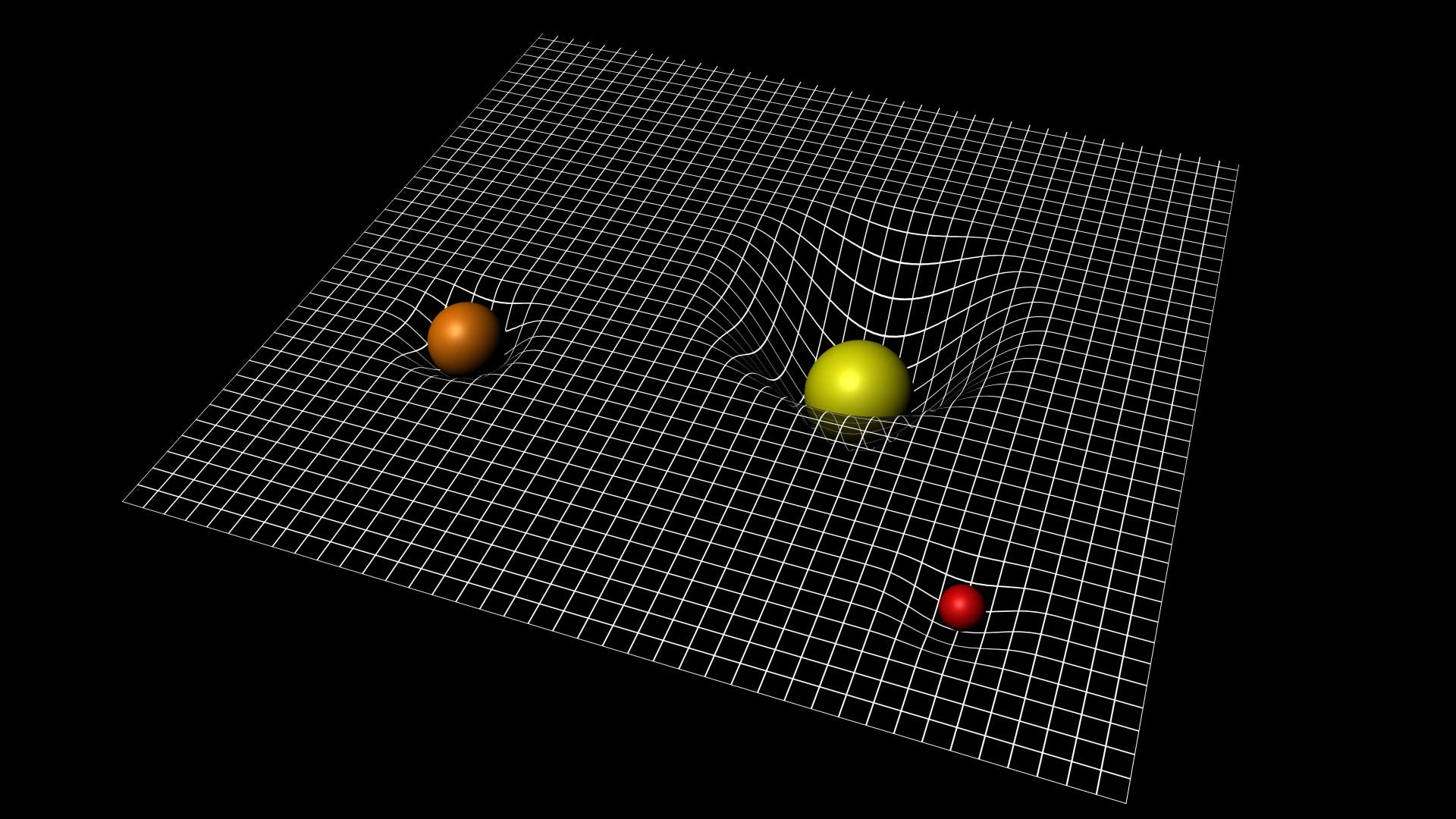
Now you can read what the rubber sheet is trying to say. The heavy ball is a star. The sheet is spacetime. The dip is the curvature. The marbles roll toward the ball not because anything pulls them, but because they’re following the curve of the surface, straight lines on a bent sheet.
It’s a good picture. Honestly, for getting the gist across, it might be the best simple picture we have.
But look at it once more, and a question should start to itch.
That sheet is a flat 2D surface, a plane, sagging downward into a third dimension to make the dip. Fine for a cartoon. But you don’t live on a 2D sheet. You live in three dimensions of space: up–down, left–right, forward–back, all at once. So if mass curves your space, real, 3D space then it bends... where? Into what? A flat sheet curves into the third dimension. What does a 3D space curve into? A fourth?
And we haven’t even mentioned time yet. Spacetime isn’t three dimensions, it’s four. The rubber sheet shows no time at all. And here’s the part that should genuinely unsettle you: for the gravity you feel every single day, the curving of time is the part that does most of the work. The sheet leaves out the single most important character in the entire story.
So the picture isn’t merely simplified. It shows you the wrong number of dimensions, omits the one that matters most, and, if you really squint — quietly cheats: those marbles only roll into the dip because real gravity is pulling them down onto the sheet. It uses gravity to explain gravity.
The truth is stranger, and far more beautiful. And it can be pictured, not perfectly, but honestly, in a way that will quietly reorganize how you feel the ground under your feet.
That’s Thursday.
On Thursday I draw you the real picture; the one the rubber sheet was always too flat to show. Not a ball in a dip, but the way space and time actually curve: the dimension the sheet leaves out, and the warping of time that turns out to be the real reason you’re pinned to your chair right now. You’ll see why the falling apple and the orbiting Moon are obeying one identical rule, and why a bend this powerful stays completely invisible to you for a single strange reason, light is simply too fast.
It’s the picture I wish someone had drawn for me years ago. Once it clicks, you won’t look at a falling object the same way again, and yes, it’s the headache I promised you back at the start.
The full picture is for paid subscribers: £5 a month gets you this piece and every deep dive like it, unlocked the moment it goes live.
Subscribe — I’ll see you Thursday.
So, if you are calculating how fast a baseball falls, you can absolutely call gravity a force. But if you are looking at the deepest truths of the cosmos, gravity is geometry.
The claimed observation of curved light around the sun during an eclipse turned out to be unreproducible, and the scientist that did it had varying resultant data, which he cherry picked through to only take the data that fit the application of Einstein theory (that Einstein was never comfortable with).
In reality, light was warped, but the warping “was all over the place” and did not have the consistency that it should have had if the Einsteinian theory was correct.
“Induced electric dipole redshift” is a theory that fits the data, and is lab reproducible… just shine a laser through an electrical current arc down a dim hallway, and see it fluctuate.
This also explains “the need for dark matter, dark energy”, and explains why quasars can be measured by redshift as being hundreds of thousands behind a galaxy from the perspective of earth, but its gravity interacts with that galaxy as though it is in the galaxy. (As Halton Arp, in the book “Seeing Red” pointed out.)